

Inverter vs Conventional Microwave: Which Technology Wins in 2026?
We have all experienced it: you place a bowl of soup or a frozen chicken breast into the microwave, set the timer, and wait. When the bell rings, the edges of your bowl are dangerously hot, but the center of your food is still ice cold.
For decades, we accepted this frustrating inconsistency as a normal part of using a microwave. However, as we move through 2026, kitchen appliance technology has evolved dramatically. The culprit behind your unevenly heated leftovers is likely the outdated technology inside your machine.
If you are shopping for a new kitchen appliance, you will inevitably hit the ultimate technical crossroads: the inverter vs conventional microwave debate. This comprehensive guide breaks down the science, real-world cooking performance, and helps you decide which technology belongs on your countertop.
Quick Answer
A Conventional Microwave uses a heavy transformer that can only blast food at 100% power, turning on and off to simulate lower heat, which often leads to burnt edges and frozen centers. An Inverter Microwave uses a solid-state circuit to deliver a steady, continuous stream of lower power (e.g., a constant 50% heat). Inverters are vastly superior for defrosting meat, melting chocolate, and evenly heating dense leftovers, while conventional units are best for budget buyers who only boil water or make popcorn.

I. How a Conventional Microwave Works: The “Pulse” Method
To understand the difference, we first have to look at the standard technology that has powered microwaves since the 1970s. A conventional microwave uses a heavy, magnetic component called a transformer to power the magnetron (the part that creates the microwaves).
This traditional transformer has a major limitation: it only knows how to operate at exactly 100% power or 0% power. It has no middle ground.
When you tell your conventional microwave to cook something at 50% power (often used for defrosting), the machine cannot actually produce a gentle 50% heat. Instead, it fakes it. It blasts your food with 100% power for a few seconds, then completely shuts off the power for a few seconds, and repeats this cycle. If you listen closely to an older microwave, you can actually hear a loud “click” followed by a hum as the magnetron turns on and off.
Why This Ruins Your Food
- Burnt Edges: During those bursts of 100% power, the outside edges of your food take the full, aggressive hit of radiation, causing proteins to denature rapidly. This causes meat to cook, harden, or turn rubbery before the inside thaws.
- Frozen Centers: Because the heat is so aggressive and intermittent, it struggles to penetrate deeply into dense, frozen foods. The outside boils while the center remains a block of ice.
- Explosions: Sudden, violent blasts of 100% power are exactly what cause butter to explode and tomato sauces to splatter all over the interior walls of your appliance.

II. How an Inverter Microwave Works: The Continuous Stream
An Inverter microwave fixes the fundamental flaw of the conventional transformer by replacing it with a modern, solid-state inverter circuit board. (This technology was originally pioneered by Panasonic but is now used by brands like LG and Bosch).
Instead of violently pulsing on and off, an inverter can regulate the flow of electricity to deliver a steady, continuous stream of power to the magnetron.
True Temperature Control
If you set an inverter microwave to 50% power, the machine delivers exactly 50% power continuously for the entire duration of the cooking time. There are no sudden blasts of extreme heat and no periods of zero heat. It operates much more like a traditional gas stove, where you can actually turn the flame down to a gentle simmer.
The gentle, steady heat has time to penetrate deeply into the center of the food, warming it evenly from the inside out without scorching the exterior surfaces.
Gentle heating is scientifically proven to retain more heat-sensitive vitamins and nutrients in vegetables compared to aggressive blasts of 100% radiation.
Because solid-state circuit boards are significantly lighter than heavy magnetic copper transformers, inverter microwaves are generally easier to move, unbox, and install.
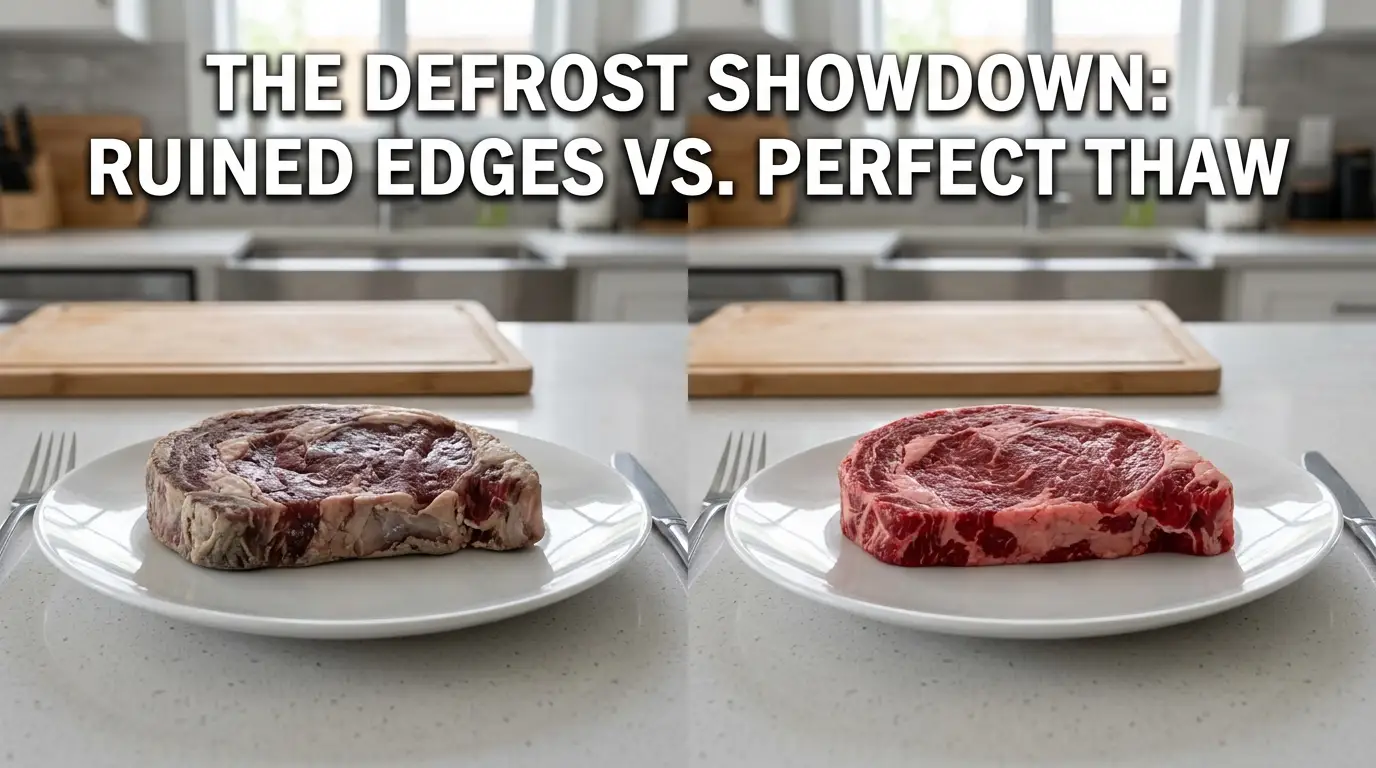
III. Head-to-Head Performance Showdown
Understanding the science is great, but how does the inverter vs conventional microwave matchup look when you are actually trying to make dinner? Let’s look at four common kitchen scenarios.
1. Defrosting Meat
Conventional: The pulsing 100% heat often begins to actually cook the thin edges of your chicken or steak while the thick center remains a block of ice. You end up with grey, rubbery edges that ruin the texture of your meal.
Inverter: The steady, low power thaws the meat gently and evenly from edge to center without cooking the exterior proteins.
🏆 Winner: Inverter (Models with “Turbo Defrost” are universally praised by home chefs).
2. Reheating Complex Leftovers (e.g., Lasagna)
Conventional: The cheese on top turns into hard, burnt plastic, the tomato sauce spatters everywhere, and the bottom center of the pasta is still cold.
Inverter: The steady heat warms the dense layers of pasta and meat evenly, melting the cheese perfectly without boiling the sauce into a volcano.
🏆 Winner: Inverter.
3. Melting Delicate Ingredients (Chocolate & Butter)
Conventional: A sudden blast of 100% power will easily scorch expensive baking chocolate, seizing it up, or cause a stick of butter to violently pop and explode, creating a massive cleaning chore.
Inverter: You can set the machine to a continuous 10% or 20% power, gently melting the ingredients just as smoothly as a double-boiler on a stovetop.
🏆 Winner: Inverter.
4. Boiling Water or Making Popcorn
Conventional: If you just need maximum 100% heat to boil a cup of water for tea or pop a bag of popcorn rapidly, a conventional microwave performs this brute-force task perfectly.
Inverter: Performs equally well at 100% power, delivering the exact same maximum output.
🤝 Winner: Tie.
IV. Quick Comparison: Pros & Cons
To make your purchasing decision easier, here is a quick breakdown of how the two technologies compare on paper:
| Feature | Conventional Microwave | Inverter Microwave |
|---|---|---|
| Power Delivery | Pulses (100% On / 100% Off) | Continuous, precise power |
| Defrosting | Poor (Often cooks the edges) | Excellent (Even, safe thawing) |
| Weight | Heavier (Due to the copper transformer) | Lighter (Solid-state circuit board) |
| Price | Highly Affordable (Under $150) | Premium Price ($150 – $400+) |
| Best For | Reheating coffee, boiling water, popcorn | Actual cooking, defrosting, delicate foods |
We’ve tested the latest models from Panasonic, LG, and Breville to find the ultimate continuous-power machines.
Read the Best Inverter Microwave Ovens 2026 Guide →
V. The Price Gap: Is the Upgrade Worth It?
The final hurdle in the inverter vs conventional microwave debate is the cost. Because conventional microwaves use older, highly standardized technology, they are incredibly cheap to manufacture. As outlined in our Best Budget Microwave Under $150 guide, you can easily find a highly reliable conventional unit for around $90.
Inverter technology requires more advanced circuitry. Therefore, a quality inverter model will typically start around $180 and can easily exceed $300 for luxury countertop or built-in models. So, should you pay the premium?
Yes, Buy an Inverter Microwave If:
- You frequently forget to take meat out of the freezer and rely heavily on your microwave’s defrost setting.
- You bring home expensive restaurant leftovers and want them to taste exactly as they did the night before.
- You enjoy cooking or baking and need to melt delicate ingredients (butter, chocolate, cheese) without ruining them.
- You want to future-proof your kitchen with a highly energy-efficient appliance.
Save Your Money & Buy Conventional If:
- You live in a dorm room or small apartment and only need an appliance for late-night ramen and popcorn.
- Your appliance budget is strictly under $150.
- You primarily use your stovetop and oven for real cooking, and view the microwave merely as a “water boiler” or quick reheating box.
👉 Read More: Best Compact Microwave for Apartments
Explore More Appliance Guides
Don’t stop here! Visit our complete hub for more expert tips, side-by-side equipment comparisons, and updated buying recommendations for 2026.
FAQ: Inverter vs Conventional Microwave
2026 Guide: Understanding Microwave Technology
The Bottom Line: If you frequently use power levels below 100% (Power Level 1-9), an inverter microwave will vastly improve your food’s texture.

