
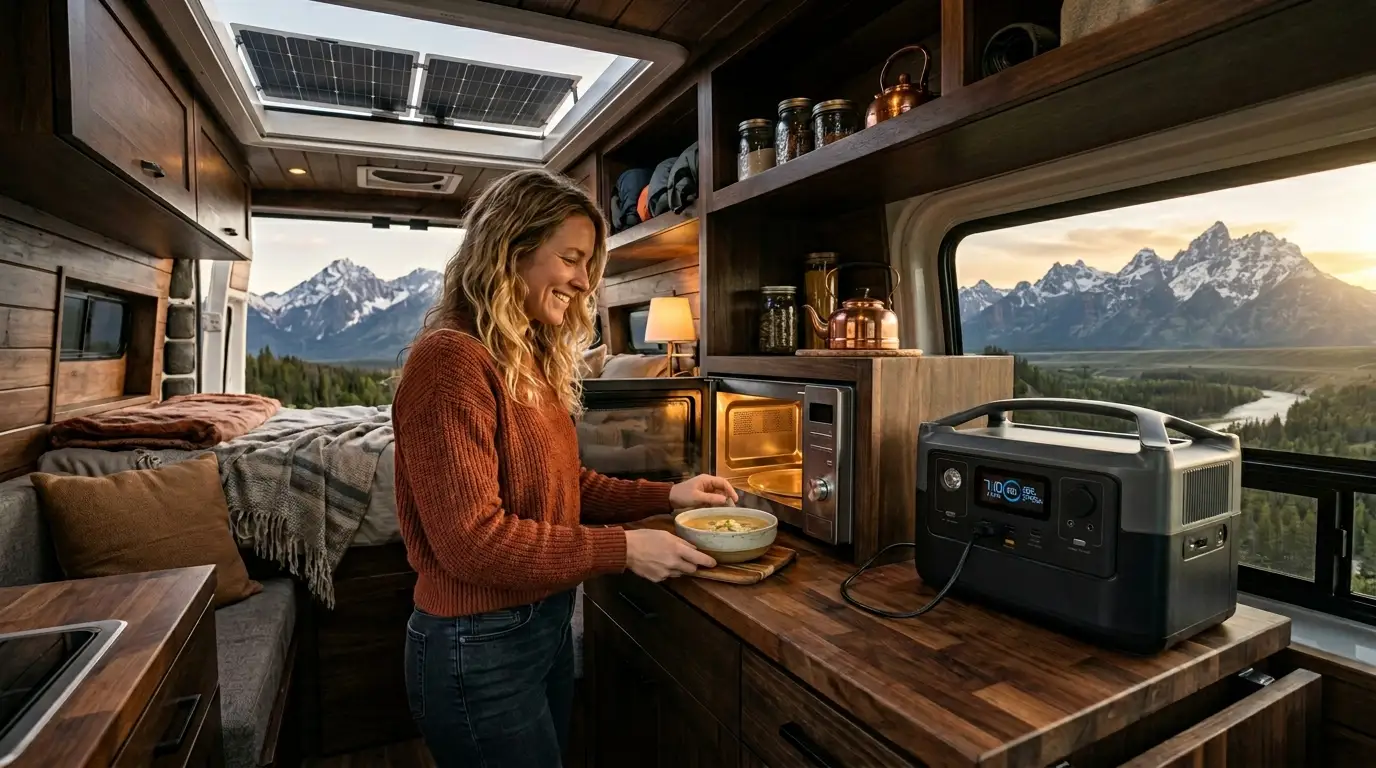
Can You Run a Microwave on Solar Power? (2026 Guide)
Whether you are outfitting a custom camper van, building an off-grid cabin in the woods, or preparing your suburban home for emergency rolling power outages, the ultimate test of any solar setup is its ability to run high-draw heating appliances.
So, the million-dollar question: Can you run a microwave on solar power?
The short answer is yes, absolutely. The long answer is that a microwave is one of the most mechanically demanding appliances you can possibly run off-grid. You cannot simply plug it into a cheap solar panel and expect it to heat your food. To run a microwave safely without destroying the appliance or melting your electrical system, you need to understand starting surges, inverter types, and battery discharge capacities.
The Quick Answer
Yes, you can run a microwave entirely on solar power, but you need a robust setup. A standard “700W” microwave actually draws over 1,100W of power and requires a massive startup surge. To run it safely, you must have a Pure Sine Wave Inverter rated for at least 2,000W continuous (to handle the surge) and a Lithium (LiFePO4) battery bank capable of discharging 100+ amps rapidly without crashing. A 100W solar panel can recharge the energy used to heat a 5-minute meal in about 90 minutes of peak sunlight.
The Hidden Catch: Starting Watts vs. Running Watts
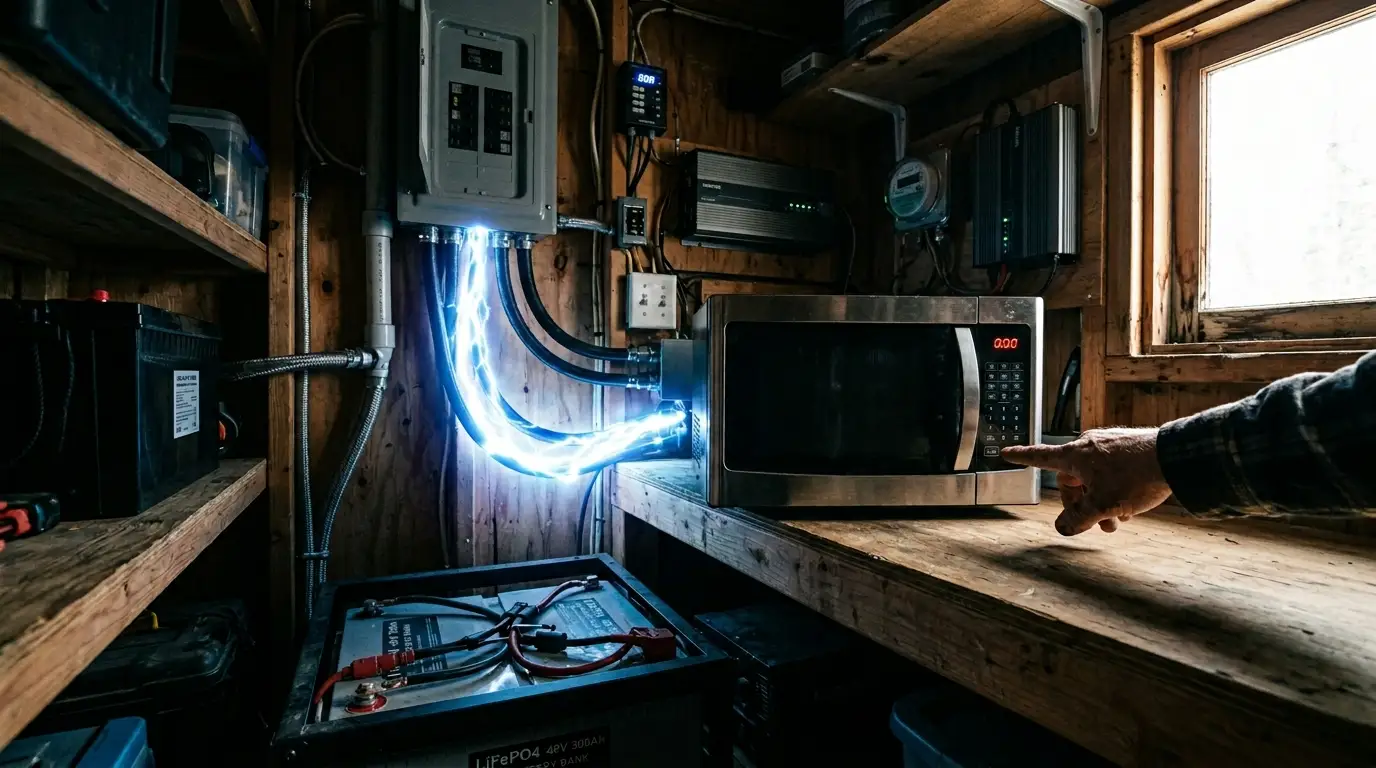
The biggest mistake beginners make when building a DIY solar setup is reading the front of the microwave and assuming that number is the total power requirement.
If your compact microwave says “700 Watts” on the door, that is strictly the cooking power (output). It is the amount of radiation hitting your food. However, due to the laws of thermodynamics and the inefficiency of the internal transformer, the actual electrical draw from the wall (input) to produce that 700W of cooking power is usually around 1050 to 1200 watts.
You can learn more about how this math works in our 700W vs 1000W Microwave Guide.
The “Surge” Requirement
Furthermore, microwaves require a massive surge of kinetic energy just to turn on the magnetron (the heavy, magnetic component that creates the microwaves) and get the cooling fan spinning. This “surge” (also known in electrical engineering as inrush current or starting wattage) can be double the running wattage for a fraction of a second.
The Rule: To run a standard 700W microwave, your solar system must be capable of handling a sudden surge of at least 1500W to 2000W for a few seconds without triggering the system’s overload protection.
The Inverter: The Most Important Component
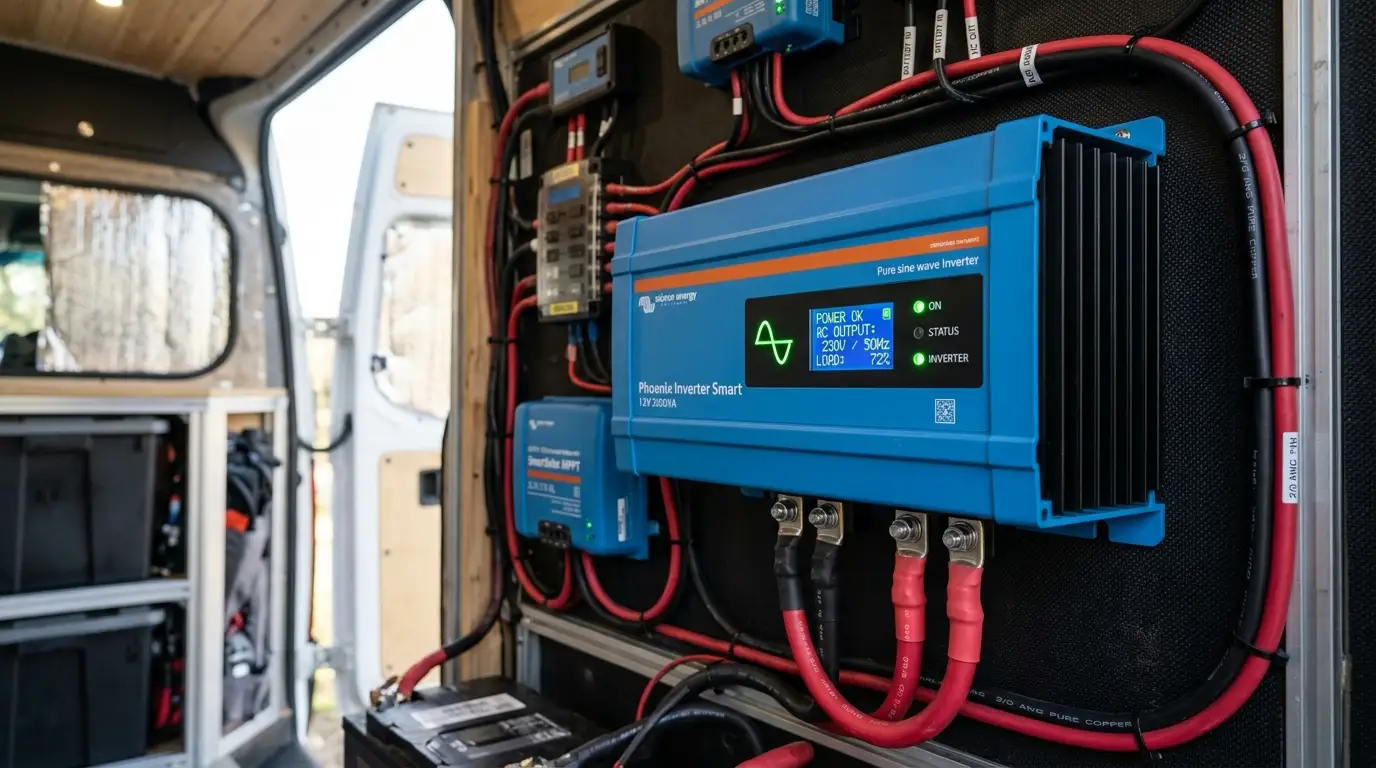
Your solar panels and batteries store Direct Current (DC) power. However, your microwave, like almost every household appliance, requires Alternating Current (AC) power to function. The inverter is the vital electronic bridge that converts the 12V or 24V DC from your batteries into 120V AC for your microwave.
If you want to run a microwave on solar power, you cannot use just any cheap inverter you find online. You must follow these two absolute, non-negotiable rules:
1. It Must Be a “Pure Sine Wave” Inverter
Never plug a modern microwave into a “Modified Sine Wave” inverter. Modified inverters produce “choppy,” block-like electricity that mimics an AC wave but isn’t perfectly smooth. Microwaves rely on precise magnetic fields to generate radiation.
If you run a microwave on a modified sine wave, it will sound incredibly loud, buzz aggressively, cook poorly (taking twice as long to heat your food), overheat the internal transformer, and eventually fry the sensitive digital circuit board. You must invest in a high-quality Pure Sine Wave Inverter to replicate the clean, smooth electricity of a city grid.
2. Size It Correctly for the Surge
As mentioned above, you need an inverter that can handle the massive starting surge, not just the running watts. A 1000W inverter will instantly shut down and display a red “Overload” fault the second you press start on a 700W microwave.
For a small RV microwave (700W output / 1100W draw), you should install a minimum of a 2000W Pure Sine Wave Inverter. For a larger residential microwave (1000W output / 1500W draw), you will need a 3000W inverter to be entirely safe and prevent system bottlenecks.
The Battery Bank: Fueling the Surge
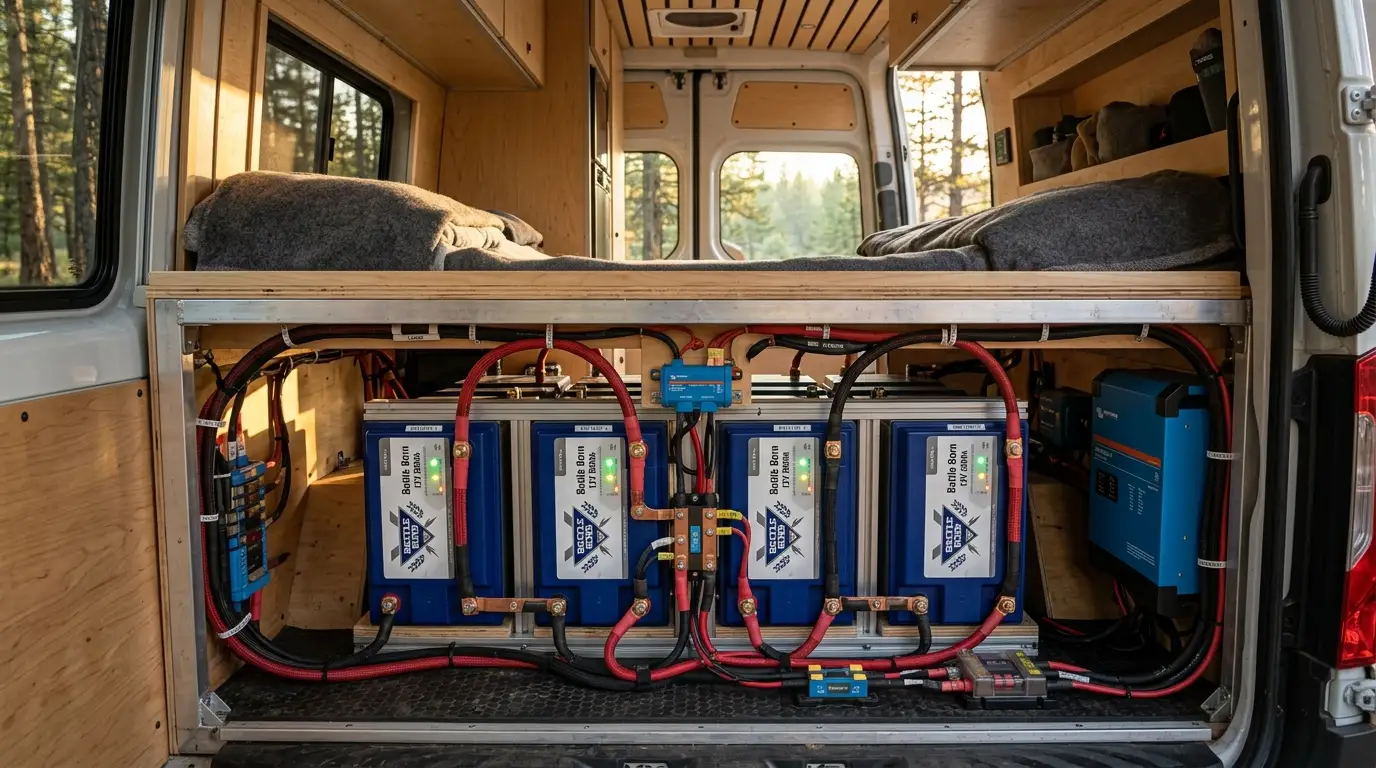
Here is a fundamental truth of off-grid engineering: Solar panels do not power the microwave directly. The sun’s energy goes from the panels, into a charge controller, and into your battery bank. The battery bank is what actually powers the inverter to run the microwave.
The Problem with Lead-Acid
Older AGM or flooded lead-acid batteries struggle to output massive surges of power quickly due to a phenomenon called voltage sag (the Peukert Effect). When you put a massive load on a lead-acid battery, its voltage drops drastically. If the voltage drops below 11V, the inverter will automatically shut off to protect itself, stopping your microwave mid-cook even if the battery is technically full.
The Lithium (LiFePO4) Solution
If you want to reliably run heating appliances off-grid, you need to upgrade to LiFePO4 (Lithium Iron Phosphate) batteries. Lithium batteries maintain a perfectly flat voltage curve until they are nearly empty, meaning they can output massive amounts of energy without triggering an inverter shut-down.
Let’s look at Ohm’s Law (Watts = Volts x Amps). A microwave pulls massive amperage. If you have a 12V system, running a 1200W microwave pulls roughly 100 Amps per hour. You need a lithium battery bank large enough (minimum 200Ah) with a high enough BMS (Battery Management System) discharge rate to handle that 100-amp draw safely without shutting down the circuitry.
The Easy Route: Portable Power Stations

If wiring charge controllers, calculating wire gauges (you need thick 2/0 AWG cables for a 2000W inverter!), wiring heavy copper busbars, and installing massive inverters sounds like a total nightmare, there is a much easier solution in 2026.
The off-grid industry has been completely revolutionized by high-capacity Portable Power Stations (Solar Generators). These are all-in-one, durable boxes that contain the lithium battery, the pure sine wave inverter, and the MPPT solar charge controller perfectly wired together by engineers. You simply plug your portable solar panels into the back to charge it, and plug your microwave directly into the front AC outlets to cook.
Top Solar Generators to Run a Microwave:
If you want a flawless plug-and-play solution, look for power stations with a continuous AC output of at least 1500W (with a 3000W peak surge capacity). Brands like EcoFlow, Bluetti, and Jackery make incredible, heavy-duty stations that can effortlessly run a microwave, a coffee maker, or even a mini-fridge during a suburban blackout or a weekend camping trip.
How Many Solar Panels Do You Need?
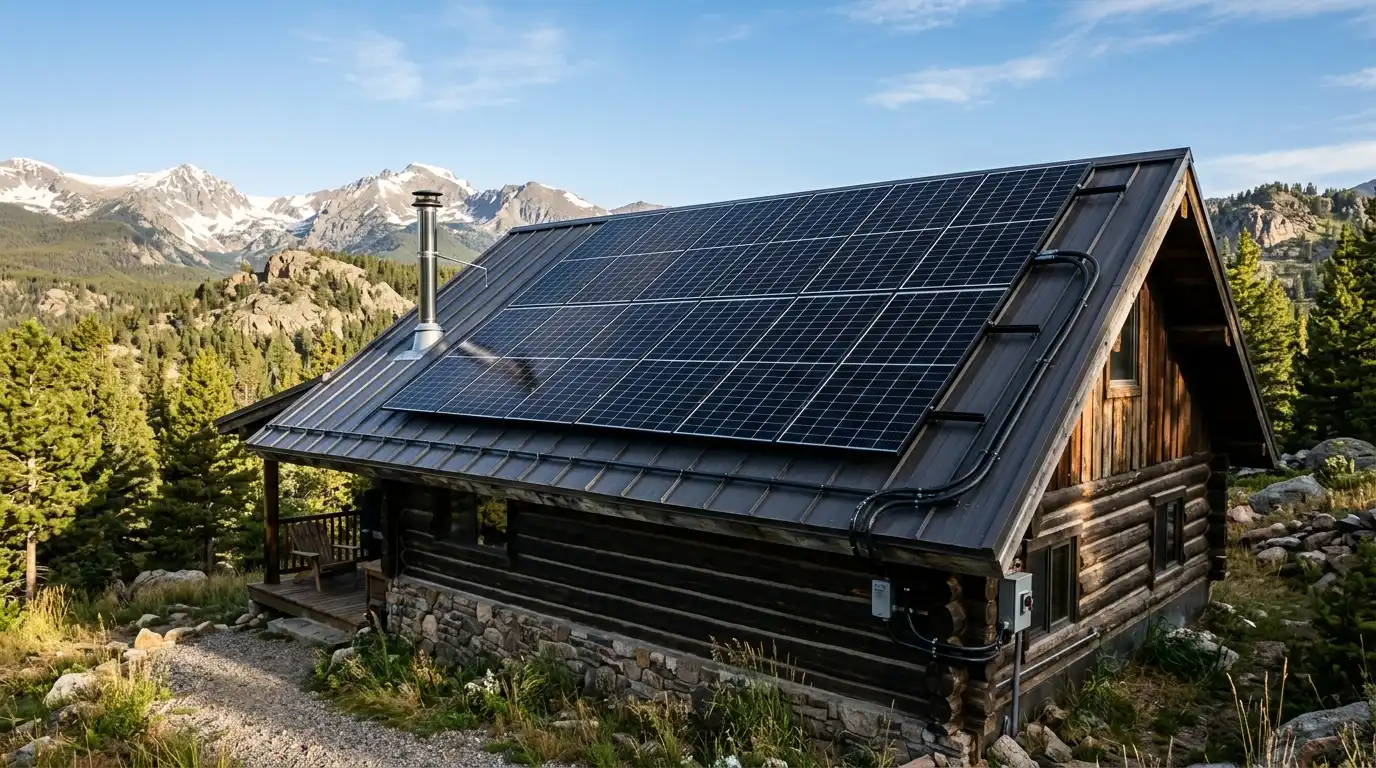
This is where the math works in your favor. Because a microwave is only used for a few minutes at a time, it actually uses very little total energy (measured in Watt-hours), despite its massive instantaneous power draw (Watts).
Let’s look at the consumption: Running a 1200W microwave for exactly 5 minutes (to heat up a large frozen meal) only consumes about 100 Watt-hours (Wh) of energy from your battery bank.
- A single 100W solar panel, operating at 80% real-world efficiency in good sunlight, produces about 80 Watts per hour.
- Therefore, one 100W panel can replenish the energy you just used to cook your meal in about an hour and a half.
Ideally, an off-grid RV or cabin running a microwave should have a minimum of 300W to 400W of solar panels on the roof. This ensures the batteries recharge incredibly quickly after cooking, leaving plenty of solar harvest leftover for running lights, charging laptops, and powering water pumps.
Explore the Appliance Energy Hub
Don’t stop here! Dive deeper into the electrical math and discover the best low-draw appliances tailored specifically for off-grid living and van life.
FAQ: Running a Microwave on Solar Power & Inverters
2026 Guide: Off-Grid Cooking Safely and Efficiently
Solar Tip: A microwave uses a lot of power, but only for a few minutes. Make sure your inverter’s SURGE rating is high enough to start the magnetron!

