
Best Countertop Microwave Ovens (2026): The Ultimate Buyer’s Guide
As of March 2026, the kitchen appliance market is undergoing its most significant transformation in decades. We are just months away from the June 22, 2026, Department of Energy (DOE) mandate, which officially ends the era of high-energy “vampire” appliances that bleed electricity even when not in use.
For the modern homeowner, buying a microwave is no longer just about finding the cheapest unit that pops corn; it’s about choosing a device that balances Inverter precision, Smart sensor technology, and standby efficiency. Whether you are designing a high-end smart home or optimizing a compact solar-powered van, the hardware you choose today must meet the rigorous standards of tomorrow.
Quick Recommendations
Panasonic NN-SN97JS
Toshiba EM131A5C-BS
Breville Combi Wave
Black+Decker Compact
Samsung MS19DG8500
Sharp SMD2470ASY
I. The 2026 Tech Shift: Inverters and Standby Power
Before looking at the specific models, it is vital to understand why the 2026 standards matter. Traditional microwaves used heavy, inefficient transformers that could only operate at 0% or 100% power. To simulate “50% power,” they simply turned the magnetron on and off in cycles, which often resulted in food being “rubbery” or “frozen in the middle.”
The Rise of Inverter Technology
The 2026 standard heavily favors Inverter technology. Unlike transformers, Inverters provide a constant, variable stream of energy, allowing for delicate tasks like poaching eggs or melting chocolate without scorching. It essentially turns a microwave into a precision cooking instrument.
Standby Power & Efficiency
Furthermore, the new DOE regulations require countertop units to consume less than 0.6 watts in standby mode. Every model on this list is chosen for its ability to bridge the gap between high-performance cooking and low-impact energy consumption. For a deep dive into the math behind these savings, see our guide on How Much Electricity Does a Microwave Use?.

II. Panasonic NN-SN97JS (Cyclonic Wave)
If you have the counter space and a family to feed, the Panasonic NN-SN97JS is the undisputed champion of the year. This isn’t just a microwave; it’s a high-precision culinary tool.
Technical Breakdown:
- Wattage: 1250W
- Capacity: 2.2 Cu. Ft.
- Technology: Cyclonic Wave with Inverter and Genius Sensor.
Why It Leads in 2026:
The Cyclonic Wave technology is the real star here. While standard microwaves fire energy in a straight line, this unit circulates it in a 3D pattern. This is the “Gold Standard” for large-batch cooking. The Genius Sensor is also highly advanced, measuring the actual steam emitted by the food to adjust power levels automatically.
- Pros: Ultra-even heating, massive capacity, and sleek aesthetics.
- Cons: Large footprint; measure your counters.
 Check Price on Amazon

III. TOSHIBA EM131A5C-BS
For most households, the Toshiba EM131A5C-BS offers the perfect balance of size, power, and price. In a market moving toward specialized tech, Toshiba has perfected the “Reliable Everyday” microwave.
Key Features:
- Wattage: 1000W
- Capacity: 1.2 Cu. Ft.
- Eco Mode & Mute Function: Perfect for modern lifestyle and efficiency.
Why we love it:
The Smart Humidity Sensor in this unit is incredibly accurate for reheating leftovers without drying them out. It also features an Eco Mode, which helps it stay ahead of efficiency regulations. For those who hate loud kitchen noises, the Mute Function allows you to turn off the end-of-cycle beep entirely.
Check Price on Amazon

IV. SAMSUNG MS19DG8500SRAA
Samsung’s MS19DG8500SRAA is designed for the modern, tech-forward kitchen. With 1.9 cu. ft. of space, it bridges the gap between mid-size and family-size units.
Smart Innovation:
- Technology: Advanced Sensor Cooking.
- Interior: Ceramic Enamel (Scratch-resistant and easy to clean).
Authoritative Insight:
Samsung has invested heavily in Ceramic Enamel interiors, which are a game-changer for maintenance. Unlike painted white interiors that can chip and lead to sparking, ceramic enamel is virtually indestructible and naturally antibacterial.
Check Price on Amazon

V. Breville BMO870BSS Combi Wave
Why have three appliances when you can have one? The Breville Combi Wave is the most versatile countertop unit on the market, acting as a microwave, air fryer, and convection oven.
The Multi-Tasker Specs:
- Technology: Element IQ.
- Specialty: Combi Cook (Using Microwave + Convection + Air Fry simultaneously).
Efficiency Angle:
By combining technologies, the Combi Wave can roast a whole chicken or “air fry” fries to a perfect crisp in a fraction of the time of a conventional oven.
Pro Tip: This unit is surprisingly quiet, featuring a “Soft Close” door that eliminates the loud slamming sound typical of budget microwaves.
Check Price on Amazon
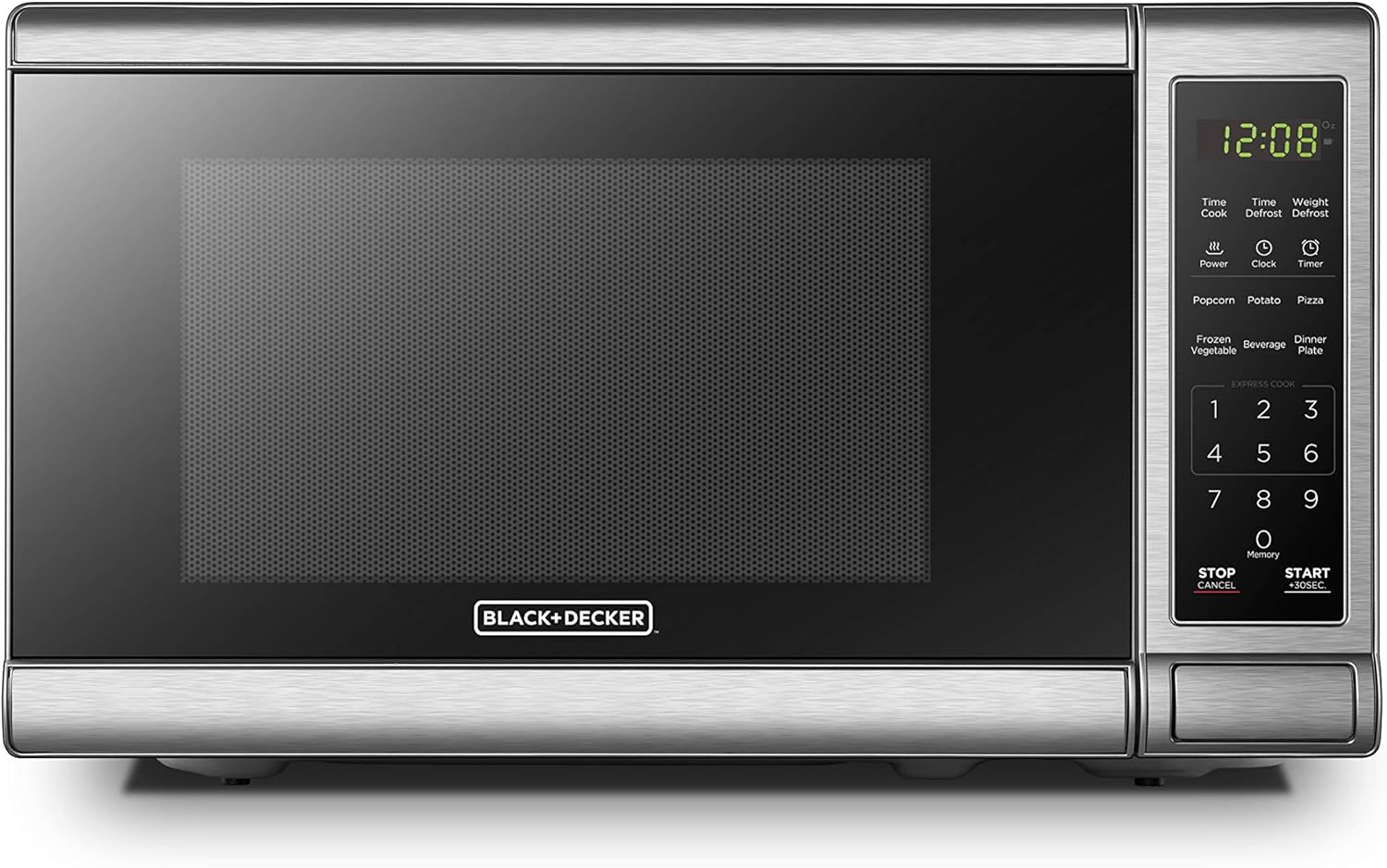
VI. BLACK+DECKER EM720CB7
For the Van Life community, dorm residents, or anyone with limited kitchen real estate, the Black+Decker EM720CB7 is the top-performing compact unit of the year.
The Small-Space Specs:
- Wattage: 700W (Cooking) | Approx. 1100W (Wall Draw).
- Capacity: 0.7 Cu. Ft.
- Design: Push-button door for durability.
Why it matters for Off-Grid:
Running a microwave on a solar battery bank is all about the “surge math.” This 700W unit is gentle on battery banks and is one of the few that won’t trip a 1500W Pure Sine Wave Inverter.
Check Price on Amazon

VII. SHARP SMD2470ASY Microwave Drawer
If you are currently renovating your kitchen and want to eliminate countertop clutter, the Sharp SMD2470ASY is the industry standard for Microwave Drawers.
High-End Integration:
- Wattage: 950W
- Installation: Under-the-counter or in a kitchen island.
- Design: Concealed control panel for a minimalist look.
Market Context:
Sharp is actually the original manufacturer for almost all luxury microwave drawers on the market. By buying the Sharp-branded version, you get the same top-tier engineering at a significantly better price.
Check Price on Amazon
VIII. Buyer’s Checklist: What to Look for in 2026
1. Inverter vs. Transformer
If the description doesn’t explicitly say “Inverter,” it’s likely an old-school transformer model. While cheaper, transformer models are less efficient and worse for food quality. In 2026, the Inverter is the clear winner.
2. Actual Power Draw
Look beyond the “Cooking Power.” A 1200W microwave can draw up to 1600W from the wall. Ensure your kitchen circuit (usually 15-20 amps) can handle the load.
3. Interior Durability
Prioritize Stainless Steel or Ceramic Enamel. Avoid white painted interiors; they rust at the seams over time, leading to hazardous sparking (arcing).
4. Material Safety
Research shows “BPA-free” plastics can leach chemicals when hit with Inverter waves. We recommend Platinum-Cured Silicone or Borosilicate Glass. See Microwave Safety Explained.
IX. Maintenance for Longevity: The $10 Fix
To keep your new 2026 microwave running at peak efficiency, you must maintain the Waveguide Cover (also known as the Mica Sheet).
This is the small, cardboard-looking square on the inside wall. If grease splatters onto this sheet, the microwave energy will “arc,” causing sparks. Many people throw away perfectly good microwaves because of this. In reality, replacing a mica sheet costs less than $10 and takes two minutes. Keeping your microwave clean isn’t just about hygiene; it’s about energy efficiency and fire safety.

