
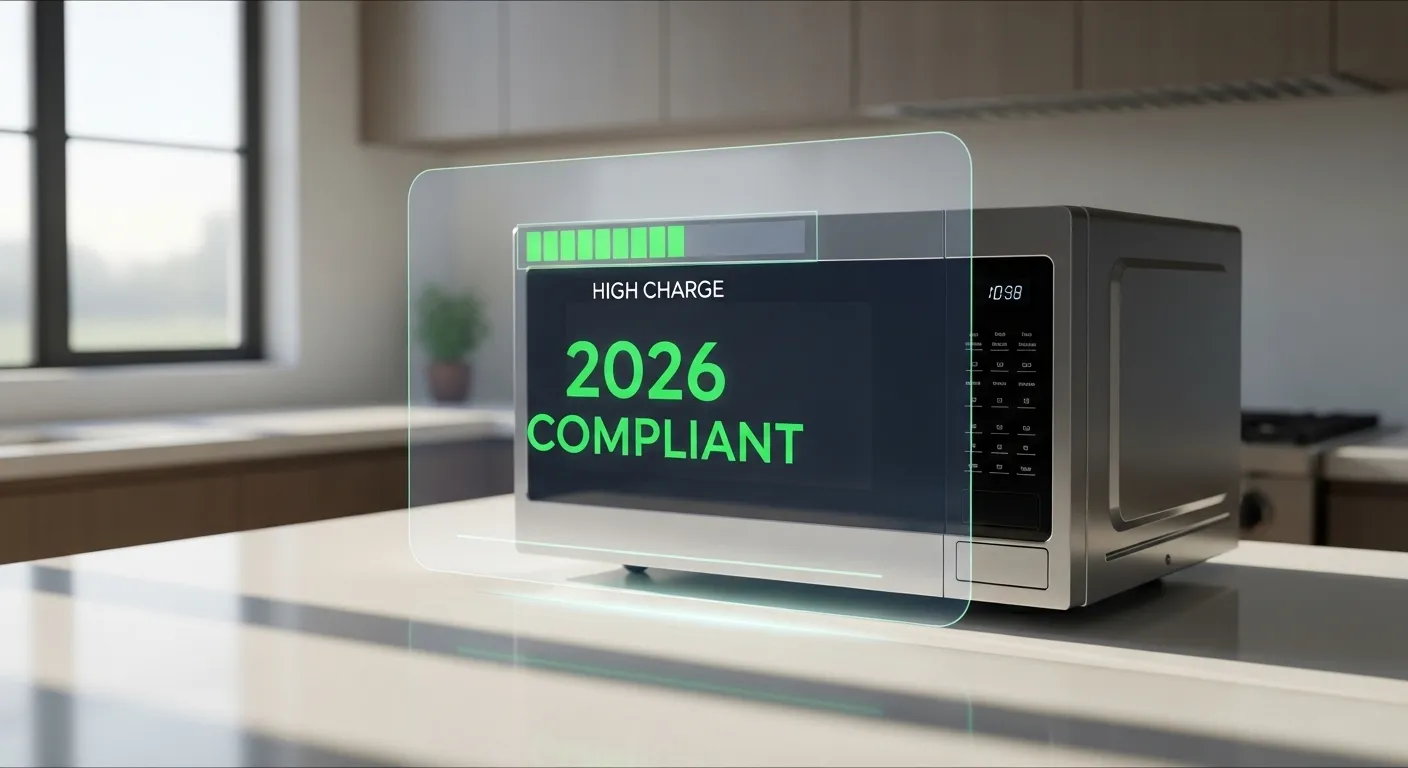
How Much Electricity Does a Microwave Use? (The 2026 Comprehensive Energy Guide)
In an era where energy prices are volatile and sustainability is no longer optional, homeowners are scrutinizing every appliance in their kitchen. The microwave oven, a staple of modern life since the late 1960s, is often praised for its speed—but speed doesn’t always translate to efficiency.
As we move into 2026, the question “How much electricity does a microwave use?” has become more complex. It’s no longer just about the three minutes it takes to pop corn; it’s about “vampire energy,” the efficiency of Inverter technology, and new federal mandates that are changing how these machines are built.
This guide will dissect the energy footprint of your microwave, helping you save money and choose the best unit for your specific lifestyle—whether you’re in a luxury kitchen or a van off the grid.
Quick Answer
Most standard microwaves use between 800 and 1,500 watts of electricity while running. However, a “1,000-watt” microwave actually draws about 1,300 to 1,500 watts from the wall due to energy loss during conversion. Additionally, standby power (the clock and sensors) can waste up to 5-7 watts 24/7. Starting June 2026, new DOE standards will mandate standby power be reduced to 0.6W for countertop models, making 2026-compliant units significantly cheaper to operate over their lifespan.
I. Understanding Wattage: Cooking Power vs. Actual Draw
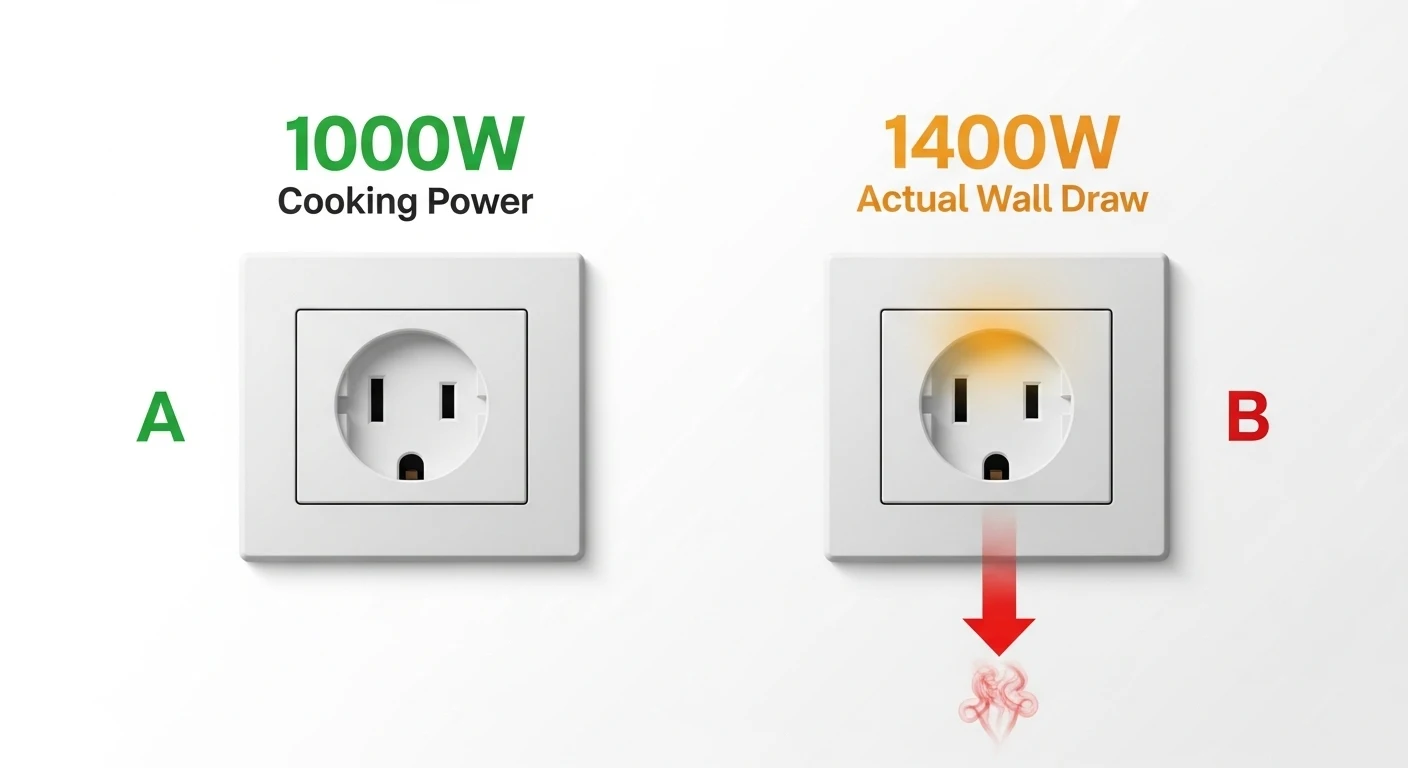
The biggest misconception in the appliance world is the wattage label on the front of your microwave. When you see a “1,000-watt microwave,” that is the output power—the amount of microwave energy the magnetron delivers to your food. This is the rating used to determine cooking times in recipes.
However, the laws of physics dictate that energy is lost during the conversion process (mostly as heat within the transformer and magnetron). To produce 1,000 watts of cooking power, a standard microwave actually draws between 1,300 and 1,500 watts from your wall outlet. This is known as the Actual Power Draw. Most entry-level microwaves are only 60-70% efficient.
- Compact Microwaves (600W-800W Output): Actual draw is roughly 900W-1,100W. Ideal for dorms, small apartments, and RVs.
- Mid-Sized Units (900W-1,100W Output): Actual draw is roughly 1,350W-1,500W. The standard for most families.
- OTR & Convection Models (1,200W+ Output): These can draw up to 1,800W or more, especially when using auxiliary convection fans or infrared browning elements.
Choosing the wrong wattage can lead to tripped breakers, especially in older homes where the kitchen circuits are already stressed by coffee makers or air fryers. For those looking to save space without sacrificing too much power, choosing the right size is critical.
Check out our breakdown of the Best Microwave Ovens for Small Kitchens to see which models balance footprint and efficiency.
II. The “Silent Thief”: Standby Power and the 2026 Mandate
While the microwave is one of the most powerful appliances when running, it spends 99% of its life doing nothing—or so it seems. The digital clock, the control panel, internal humidity sensors, and Wi-Fi modules are constantly sipping electricity. This is called Standby Power or “Vampire Power.”
The DOE 2026 Revolution
Recognizing that millions of microwaves across the country are wasting gigawatts of energy 24/7, the U.S. Department of Energy (DOE) has mandated a structural shift. Starting June 22, 2026, new standards require:
- Countertop Models: Must reduce standby power to a maximum of 0.6 watts.
- Built-in/OTR Models: Limited to 1.0 watt.
Currently, many older models draw between 3W and 7W in standby. While a 5-watt difference seems negligible, it adds up to 43.8 kWh per year. Across millions of homes, this is the equivalent of several coal-fired power plants. For the savvy consumer, upgrading to a 2026-compliant model is a major step toward a “passive” energy-saving home.
For high-end installations like luxury kitchen islands, standby efficiency and sensor technology are major selling points of 2026 models.
See our 2026 Best Microwave Drawers →
III. How to Calculate Your Monthly Cost
To truly understand your energy bill, you need a simple formula. Electricity is billed by the Kilowatt-hour (kWh), which equals 1,000 watts of use for one hour.
The Comprehensive Calculation Formula:

Real-World Scenario:
Assume you have a 1,200W (actual draw) microwave used for 20 minutes (0.33 hours) a day at a national average rate of $0.16 per kWh.
- Cooking Usage: (1,200W * 0.33 hours * 30 days) / 1000 = 11.88 kWh.
- Vampire Usage (Older model at 6W): (6W * 24 hours * 30 days) / 1000 = 4.32 kWh.
- Monthly Total: 16.2 kWh * $0.16 = $2.59 per month.
While $2.59/month isn’t breaking the bank, multiplying this across all your kitchen appliances (refrigerator, toaster, oven) reveals why energy efficiency is the “hidden” raise in your bank account. Over a 10-year lifespan, an inefficient microwave could cost you over $100 more in electricity than a DOE 2026-compliant unit.
IV. Inverter vs. Conventional: The Efficiency Battle
If you are shopping for a new unit, you will likely see the term “Inverter Technology” popularized by brands like Panasonic and LG. This isn’t just a marketing buzzword; it’s an engineering leap that fundamentally changes how electricity is consumed.
Conventional Microwaves
Uses a heavy copper transformer. It can only operate at 0% or 100% power. To “cook” at 50% power, it pulses the magnetron on and off. This constant cycling is inefficient and wastes energy during every startup spike.
Inverter Microwaves
Uses a variable power circuit board. If you set it to 50% power, the magnetron delivers a continuous 50% stream. This results in 15-20% less energy consumption for tasks like defrosting or melting butter.
Inverters are lighter, more efficient in energy conversion, and significantly faster at defrosting, which reduces the total time the appliance is running. If you’re torn between a standard model and a high-tech version, read our comparison on Inverter Microwave vs Convection Microwave.
V. Microwaves for Van Life and Solar Power

For the “Van Life” community or those living off-grid, every watt is a precious resource drawn from a limited battery bank. Running a microwave on solar power requires a high-quality Pure Sine Wave Inverter. Cheap modified sine wave inverters can damage the sensitive circuitry of modern microwaves or cause the magnetron to hum loudly and cook inefficiently.
Because a microwave has a high “surge” or “startup” requirement (the initial burst needed to activate the high-voltage transformer), we recommend a 2,000W inverter even for a small 700W microwave. If your system is struggling, you might need to look for low-wattage units.
For a complete guide on mobile power management, see our top picks for the Best Microwave for RV and Van Life.
VI. Energy Efficiency vs. Other Appliances
Is a microwave more efficient than a traditional oven? In almost every “small to medium” reheating task, the answer is a resounding yes.
| Task | Microwave | Traditional Oven |
|---|---|---|
| Heating a Potato | ~0.1 kWh (5 mins) | ~2.0 kWh (45 mins) |
| Boiling 2 Cups of Water | ~0.06 kWh (3 mins) | ~0.15 kWh (Electric Stovetop) |
| Reheating Leftovers | Definitively faster/cheaper | Wastes energy heating air/walls |
The Air Fryer Rivalry: Air fryers have taken the world by storm. While they use similar wattage (~1,500W), they often run for 15-20 minutes to achieve crispness, whereas a microwave finishes a reheating job in 2-5 minutes. For pure reheating, the microwave remains the undefeated champion of energy conservation. If you want the best of both worlds, consider a Best Microwave Air Fryer Combo to save both energy and counter space.
VII. Maintenance: Don’t Let a $10 Part Double Your Bill
Efficiency drops significantly when a microwave is poorly maintained. Two common issues can cause your unit to draw more power or fail entirely, forcing expensive replacements.
Waveguide Cover (Mica Sheet)
This small plate inside the microwave protects the magnetron from grease and food splatter. If it becomes covered in grease, it can cause “arcing” or sparking. This wastes massive amounts of energy and will eventually destroy the magnetron. Replacing it costs less than $10. Learn more in our Microwave Sparking Inside: Causes and Fix guide.
Door Seals & Samsung Error Codes
If the door is slightly misaligned, safety sensors might keep the internal fan running longer than necessary. Samsung models are particularly prone to the “SE” or “5E” error code, often related to the touchpad or sensor. Before disposing of your unit, consult our Samsung Microwave SE Error Fix.
Common Energy & Maintenance Mistakes
Efficiency drops significantly when a microwave is poorly maintained. Don’t let a $10 part double your bill.
- ❌ Dirty Waveguide Cover: This mica sheet protects the magnetron. If covered in grease, it can cause sparking (arcing), which wastes massive energy and can destroy the magnetron. Replace it for less than $10 using our Microwave Sparking Inside: Causes and Fix.
- ❌ Worn Door Seals: If the door is misaligned, safety sensors might keep internal fans running longer than necessary. Check your seals annually to ensure no microwave leakage and optimal energy containment.
- ❌ Ignoring Error Codes: Samsung models often show “SE” or “5E” error codes related to the sensor pad. Before replacing the unit, read our Samsung Microwave SE Error Fix.
VIII. Material Safety: Energy and Heat Retention
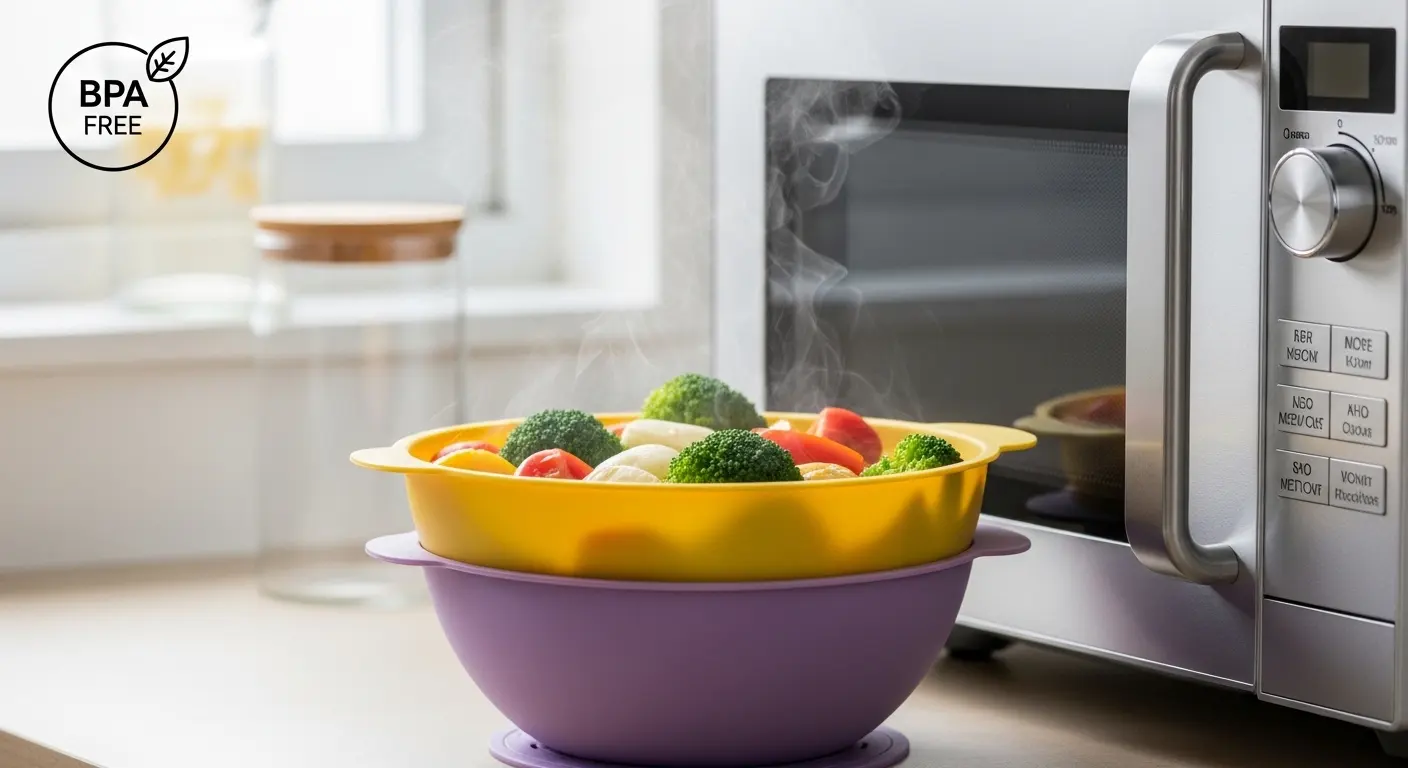
What you cook in matters as much as what you cook with. Certain materials absorb microwave energy before it ever reaches your food, leading to longer cook times and wasted electricity.
- Glass and Ceramic: Excellent heat retention, but they can be slow to heat up initially.
- Platinum-Cured Silicone: The rising star of 2026. It is chemically stable and doesn’t absorb microwave energy, ensuring 100% of the power goes into the food. See our Silicone vs Plastic Microwave Containers.
- Avoid Cheap Plastics: They often warp and can leach chemicals like BPA/BPS. Warped containers may also interfere with how waves distribute inside the oven.

