
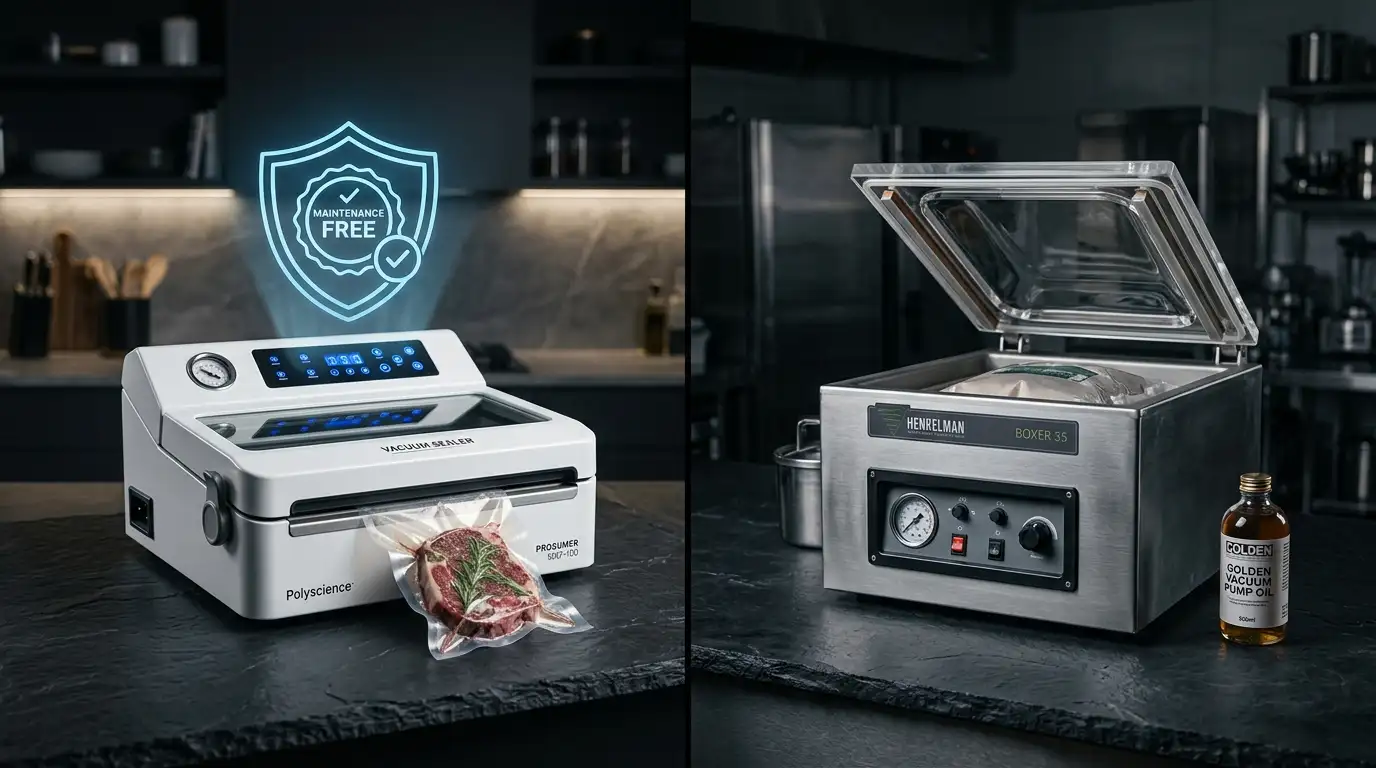
Oiled vs. Oil-Less Chamber Vacuum Pumps: Best for Long-Term Processing? (2026 Guide)
When you finally decide to ditch the frustrating, liquid-spilling external suction machines and upgrade to a heavy-duty Chamber Vacuum Sealer, you are faced with a massive technical decision before you even hit checkout.
Look at the dense, highly technical spec sheet of any premium commercial machine, and you will inevitably see the internal engine listed as either a Dry (Oil-Less) Pump or an Oiled Pump.
To the average home chef, an indoor kitchen appliance that requires “oil changes” sounds like a terrifying piece of garage machinery. Why would anyone willingly buy a kitchen gadget that needs mechanical maintenance when seemingly identical maintenance-free options exist on the exact same shelf? The answer comes down entirely to raw processing power, thermodynamic heat limits, and the exact volume of meat you plan to seal in a single weekend.
If you are dropping over $500 on a lifetime culinary investment, you cannot afford to choose the wrong engine. In this Oiled vs. Oil-Less Chamber Vacuum Pump showdown, we break down cooldown times, suction strength, and the reality of maintenance. For a complete look at our head-to-head machine reviews, explore our master directory: The Ultimate Vacuum Sealing Hub: Food Storage, Sous Vide, Mason Jars & Buying Guides (2026).
The Quick Answer
Oil-Less (Dry) Pumps are fantastic, maintenance-free engines found in prosumer countertop models designed for standard home kitchens. You never have to add fluids, but because they lack liquid cooling, they will overheat and trigger a mandatory 30-minute cooldown if you try to seal massive batches back-to-back. Oiled Pumps are industrial-grade rotary vane engines designed for commercial workloads. The liquid oil acts as a powerful coolant and a perfect mechanical seal, allowing the machine to pull a drastically deeper vacuum (over 29.5 inHg) and run continuously for 8+ hours without stopping. However, they require you to manually check and change the fluid periodically.
I. Oil-Less Pumps (The Maintenance-Free Option)

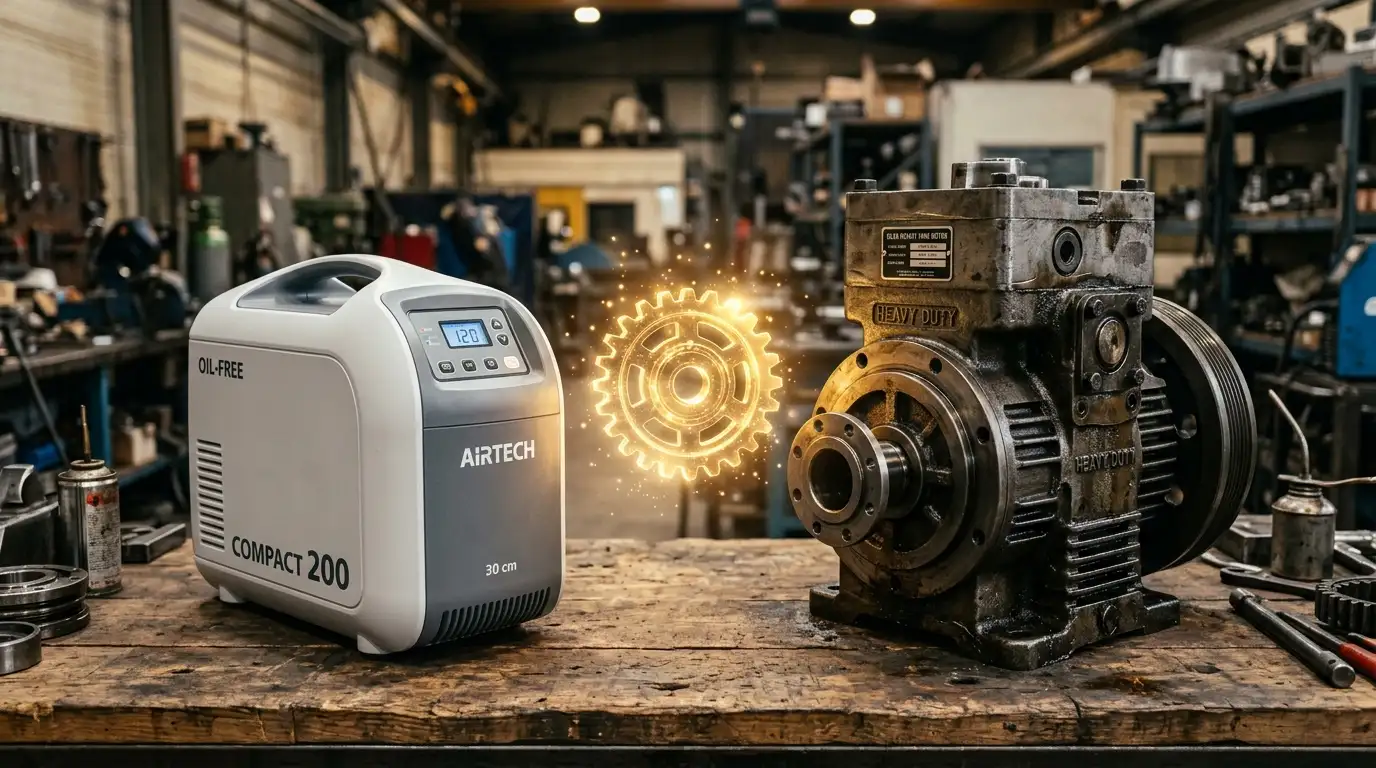
Often referred to in the appliance industry as “Dry Pumps” or “Dry Piston Pumps,” these engines are typically found in high-end, prosumer, entry-level chamber sealers designed explicitly for the aesthetic constraints and conveniences of a standard home kitchen.
How It Works: The PTFE Piston
These pumps use a heavy-duty, dual-cylinder piston that rapidly slides up and down to pull the vacuum from the chamber. Because there is no liquid oil pool inside the casing, the internal metal components are heavily coated in self-lubricating synthetic materials (typically Polytetrafluoroethylene, commonly known as Teflon or PTFE). This slick coating reduces internal wear and allows the piston to generate impressive suction purely through mechanical tolerances.
The Pros: Total Convenience
- Zero Maintenance: You unpack the machine, plug it into your kitchen outlet, and it works. You never have to buy synthetic vacuum oil, check a glass sight window, or worry about accidentally spilling thick lubricants on your expensive quartz countertops.
- Lighter and More Portable: Without the massive metal housing required to hold a deep oil reservoir, dry pumps are significantly lighter. This makes the overall appliance much easier to lift, move, and store in a lower cabinet when not in use.
The Cons: The Cooldown Limit
The laws of thermodynamics cannot be cheated: kinetic friction creates intense heat. Because there is no circulating liquid oil to absorb and dissipate the heat generated by the fast-moving piston, dry pumps run much hotter and noticeably louder.
If you try to seal 50 bags of meat back-to-back in rapid succession, the internal temperature of an oil-less pump will eventually skyrocket. To prevent the motor from literally melting itself, the machine will trigger an internal thermal overload switch, forcing a mandatory 20 to 30-minute cooldown period before you can press the start button again. If you are processing a massive elk harvest, this forced downtime is agonizing.
II. Oiled Pumps (The Commercial Workhorse)
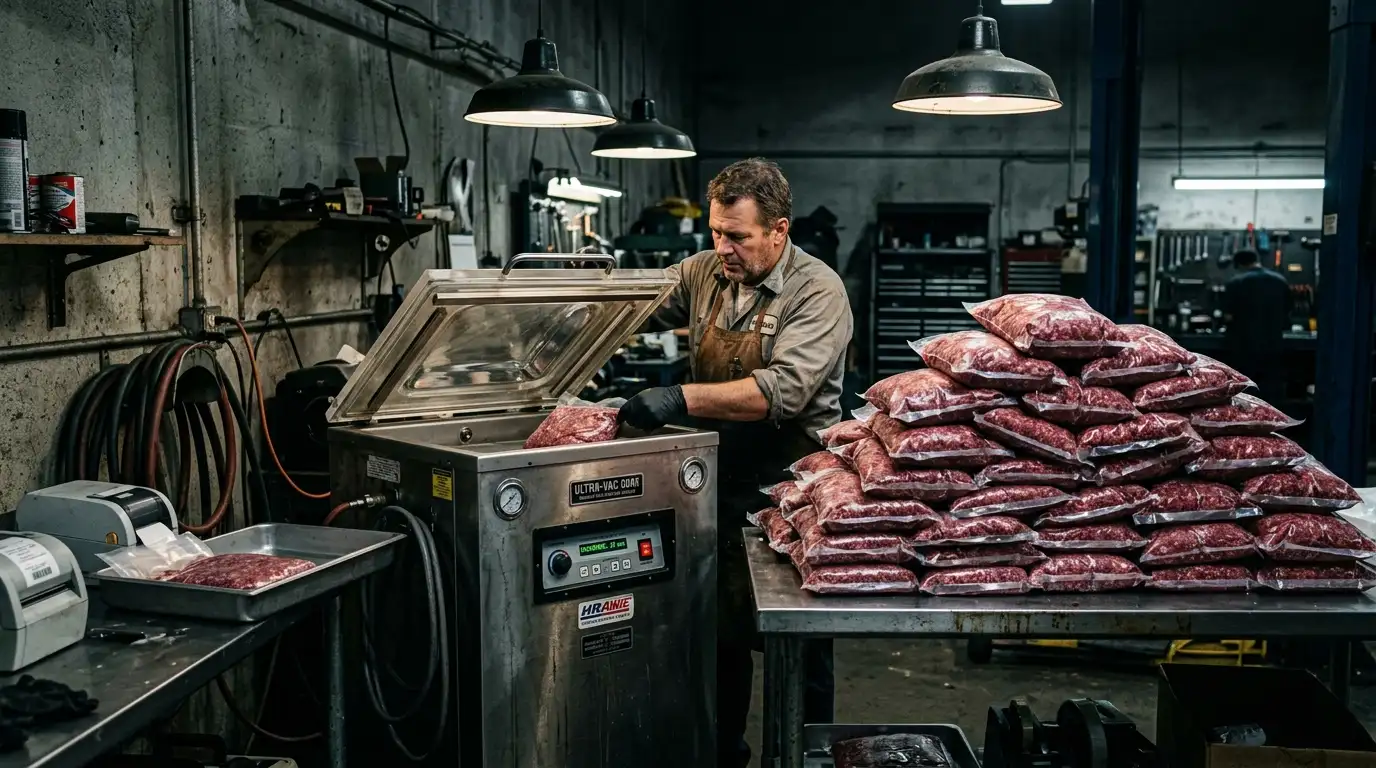
Oiled pumps (technically known in engineering circles as “Rotary Vane Pumps”) are the undisputed, heavy-duty kings of commercial meat processing. They are the massive engines powering the legendary machines we rigorously tested and reviewed in our LEM MaxVac vs. MEAT! Chamber Sealer: The Ultimate Processing Showdown.
How It Works: Centrifugal Force
Inside the heavy metal pump housing, an offset rotor containing sliding metal vanes spins at incredibly high speeds to aggressively evacuate the air from the chamber. The entire moving mechanism is constantly bathed in a specialized, high-grade synthetic vacuum pump oil.
The Pros: Endless Processing Power
- Thermal Endurance: The circulating liquid oil acts as both an incredible lubricant and a highly efficient liquid cooling system. It actively strips the heat away from the spinning metal. An oiled pump can literally run continuously for 6 to 8 hours straight without ever overheating or needing a break.
- The Perfect Micro-Seal: This is the secret to their raw power. The oil forms a microscopic, perfectly airtight liquid seal against the walls of the spinning cylinder. Because air cannot slip back past the blades, oiled pumps pull a significantly deeper, harder vacuum (often exceeding 29.5 inHg of atmospheric pressure). This physically rips the microscopic oxygen right out of the food’s cellular structure much faster and vastly quieter than any dry pump.
The Cons: Mechanical Chores
They require mechanical maintenance. You must actively monitor the oil clarity and change the fluid periodically. Furthermore, the massive metal oil housings add a brutal 20 to 30 pounds of dead weight to the appliance, making it incredibly difficult to move once you place it on a workbench.
III. The Reality of Pump Maintenance (It Takes 3 Minutes)
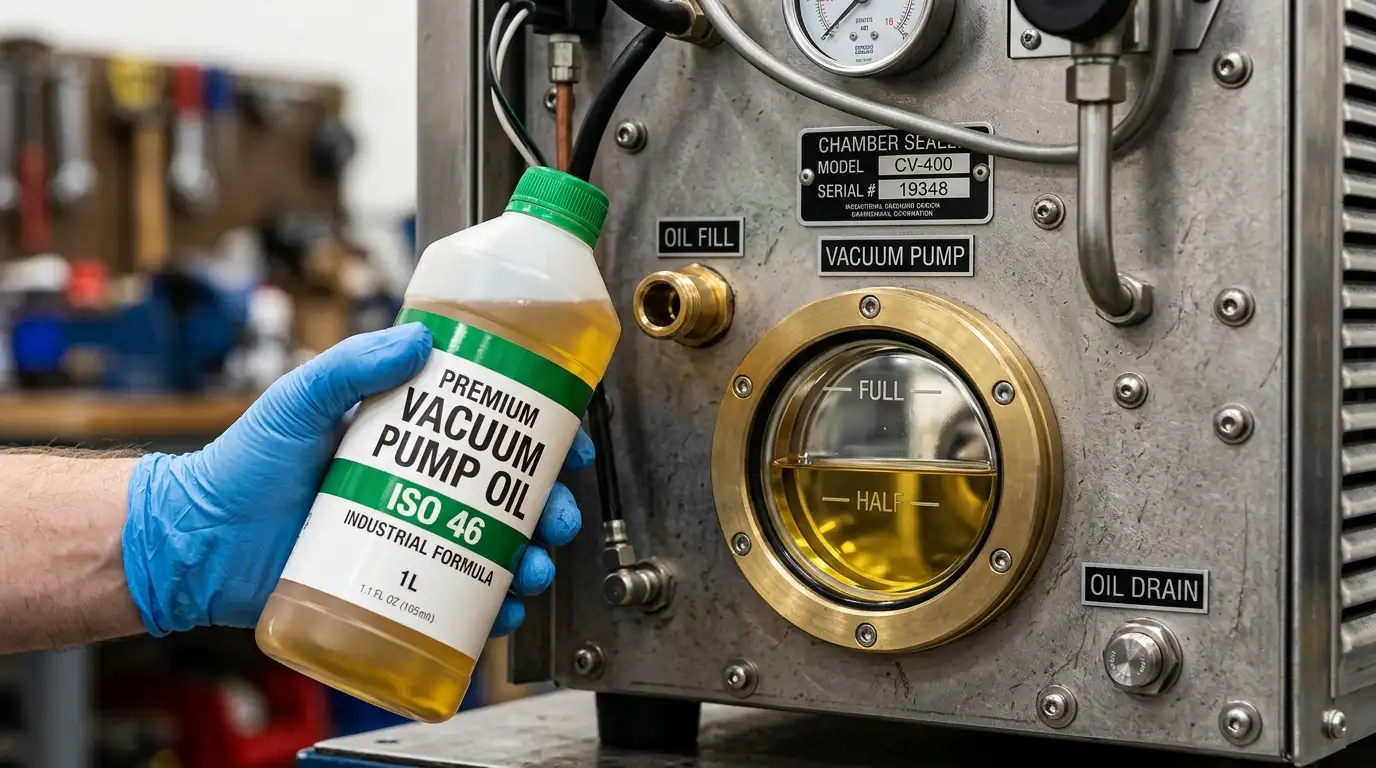
The biggest deterrent keeping home chefs from buying an oiled chamber sealer is the intimidating fear of “engine maintenance.” In reality, changing the oil is a remarkably clean, simple process that takes less than five minutes.
Why Does the Oil Need Changing?
Vacuum pumps do not have combustion engines; the oil doesn’t turn black from exhaust soot like a car. The enemy here is moisture.
Because a chamber sealer drops the atmospheric pressure so low, liquids (like wet marinades or the natural juices in fresh meat) literally begin to boil at room temperature. This creates vapor. That wet vapor gets sucked out of the chamber, travels through the exhaust port, and inevitably mixes with the oil inside the pump. Over dozens of cycles, the water emulsifies with the oil, turning the clear liquid into a cloudy, milky, white sludge. Once the oil is saturated with water, it loses its ability to lubricate the spinning vanes effectively.
The 3-Step Oil Change Process
Every oiled machine features a small, clear glass window on the back or side of the chassis called a “Sight Glass.” When you look at the sight glass, the oil should be filled exactly halfway and look perfectly clear, like a pale honey.
- Drain: Place a small disposable plastic cup under the drain plug. Use an Allen wrench to unscrew the bolt. The cloudy, old oil will simply flow out in seconds.
- Secure: Wipe the threads clean with a paper towel and tighten the bolt firmly back into place.
- Refill: Unscrew the top fill port and slowly pour fresh, manufacturer-approved synthetic vacuum pump oil in until the liquid level reaches the halfway mark on the glass window. Do not overfill it! For a typical homesteader or seasonal hunter, this incredibly simple chore only needs to be done once a year.
IV. Quick Comparison: Oiled vs. Oil-Less
| Feature | Oil-Less (Dry Piston) | Oiled (Rotary Vane) |
|---|---|---|
| Maintenance | Zero maintenance required | Requires periodic oil changes |
| Continuous Run Time | Low (Needs cooldowns after heavy use) | Unlimited (Can run all day) |
| Noise Level | Loud and mechanical | Very quiet, smooth hum |
| Vacuum Strength | Strong (Great for home use) | Exceptional (Commercial grade) |
| Weight & Price | Lighter, generally cheaper | Extremely heavy, higher premium |
Explore the Vacuum Sealing Hub
Don’t stop here! Dive deeper into the science of preservation, explore head-to-head machine comparisons, and read our latest hardware reviews for 2026.
FAQ: Chamber Sealer Pumps
2026 Guide: Maintenance, Oil Types & Overheating
Maintenance Tip: If your oiled pump’s sight glass looks cloudy or milky, it means moisture has contaminated the oil. Change it immediately to prevent internal rust!

