
12V DC Compressor Fridge vs Propane Fridge for Off-Grid Living (2026 Guide)
When you transition from a traditional, grid-tied home to a custom campervan, an RV, or a remote off-grid cabin, your entire relationship with electricity fundamentally changes. Suddenly, you can no longer blindly rely on an endless supply of 120V grid power to keep a massive, energy-hungry kitchen appliance running 24/7.
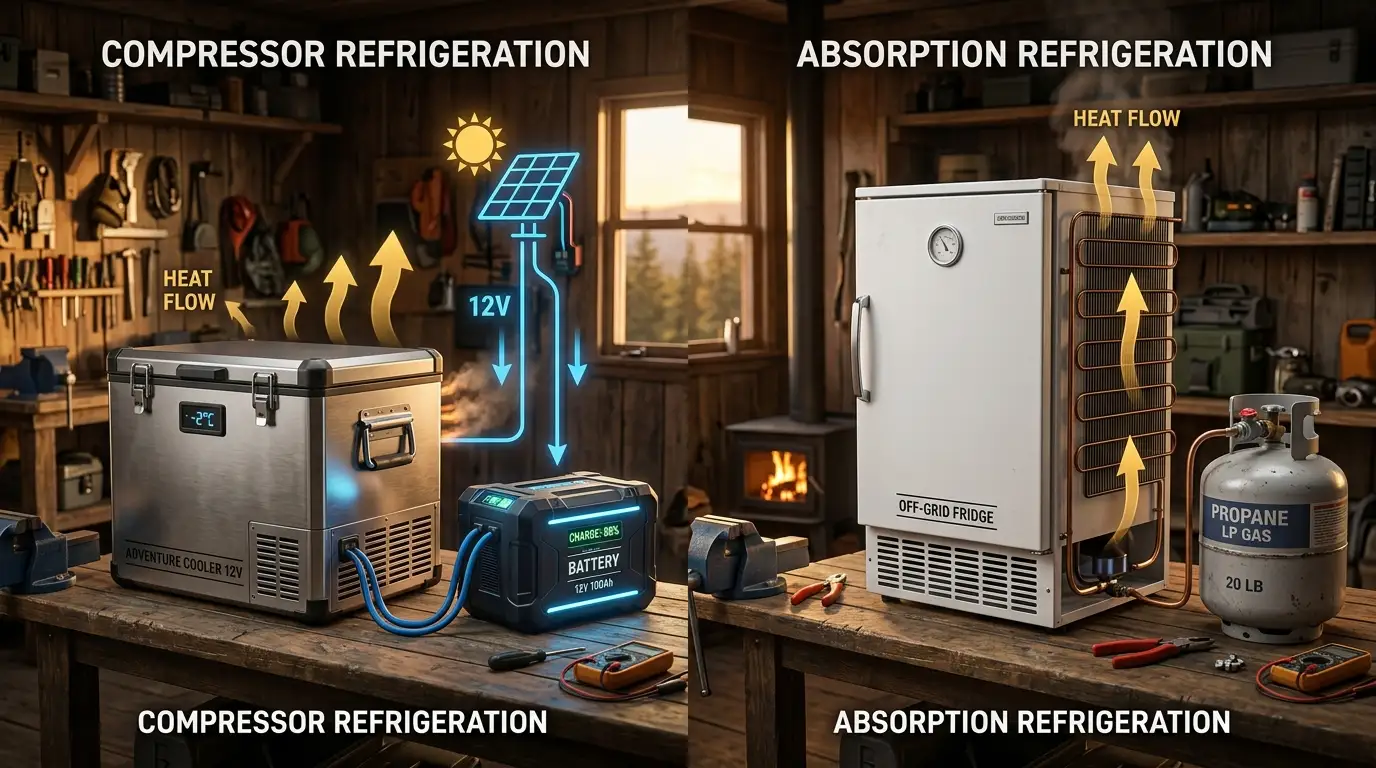
The absolute heart of any off-grid kitchen is the refrigerator. If it fails, or if it drains your battery bank entirely, you lose your entire perishable food supply. When outfitting a mobile or remote setup in 2026, you are immediately faced with a major technical and architectural decision: should you install a high-tech 12V DC compressor fridge or a traditional 3-way propane (absorption) fridge?
Much like the technical debate we covered in our Thermoelectric vs Compressor Mini Fridge guide, the core cooling technology you choose dictates exactly how you must build the rest of your physical space. In this comprehensive guide, we break down the thermodynamics, power draws, and critical environmental limitations of both systems so you can build a highly reliable off-grid kitchen.
The Quick Answer
A 12V DC Compressor Fridge is the undisputed champion for campervans and overlanding. It uses highly efficient solar battery power, cools aggressively in 100°F+ heat, requires no external venting, and operates flawlessly on steep, bumpy inclines. A Propane (Absorption) Fridge is best for stationary off-grid cabins or traditional RVs parked on flat concrete. It is completely silent and saves your battery bank by burning liquid propane, but it struggles in extreme heat and will permanently break if operated on uneven ground.
I. How 12V DC Compressor Fridges Work

A 12V DC compressor fridge uses the exact same fundamental thermodynamic cooling technology as the massive appliance sitting in a standard residential kitchen, but it is engineered to run directly on direct current (DC) instead of alternating current (AC).
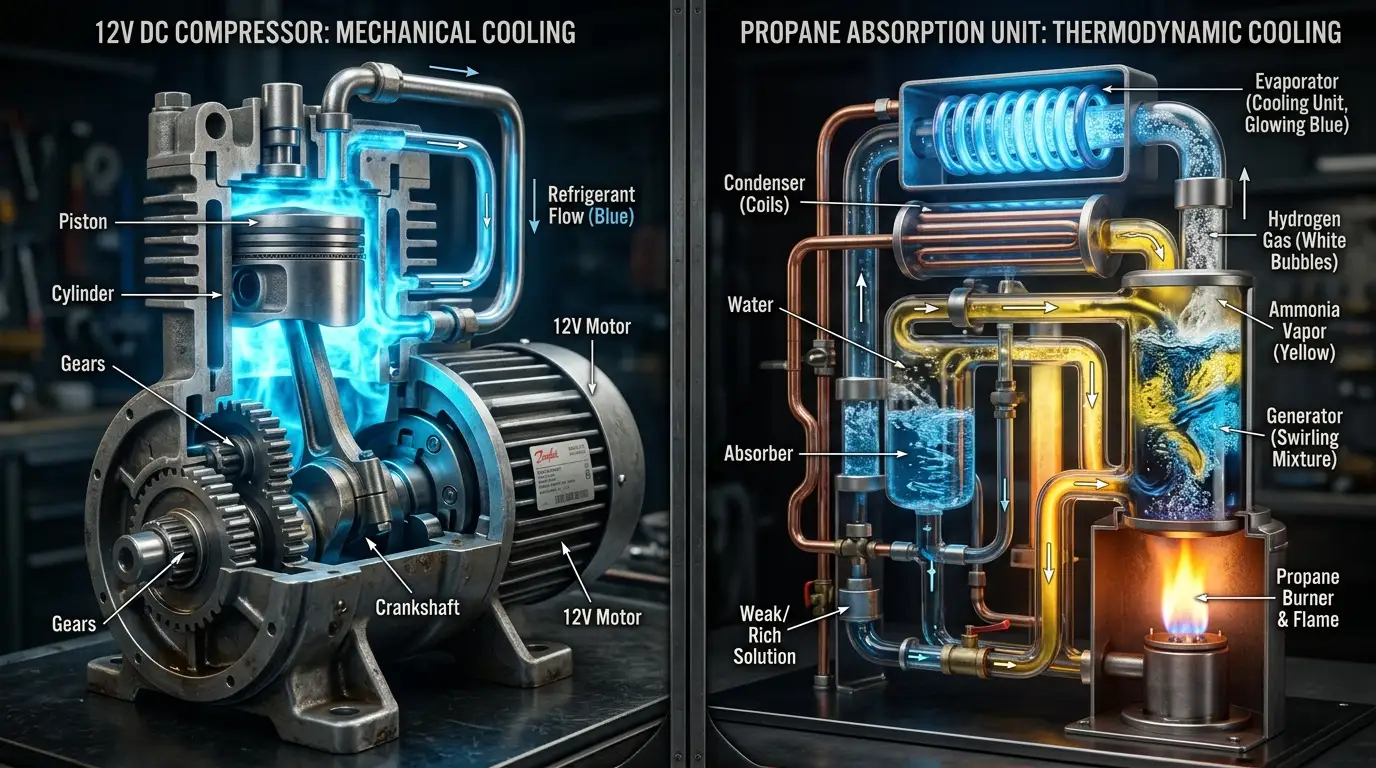
Why does this matter? If you use a standard 120V AC dorm fridge in a van, you have to leave your power inverter running 24/7 to convert your 12V battery power into 120V AC power. This conversion process wastes roughly 10% to 15% of your total energy as heat. A true 12V fridge bypasses the inverter entirely. It uses a tiny, highly efficient 12V motor (typically a legendary Danfoss/Secop compressor) to aggressively pump liquid chemical refrigerant through a series of copper coils to extract heat from the interior.
The Power Source
These fridges are powered exclusively by your 12V or 24V battery bank (usually modern Lithium Iron Phosphate/LiFePO4 or older AGM batteries), which is dynamically recharged by solar panels on your roof, a DC-to-DC charger connected to your vehicle’s alternator while driving, or shore power when parked at a campsite.
The Pros of 12V Compressor Fridges
- Incredible Electrical Efficiency: Modern 12V compressors draw very little power. A standard 50-liter van fridge might only pull 3 to 4 amps when running. Furthermore, they operate on a duty cycle. Once the fridge reaches its target temperature, the motor shuts off entirely. It only kicks on occasionally (about 25% to 30% of the time) to maintain the chill, meaning it may only consume 25 to 35 Amp-hours (Ah) per day.
- High Performance in Extreme Heat: Unlike other systems, a mechanical compressor can aggressively cool your food even if it is 100°F (38°C) inside your van. It does not rely on ambient room temperature differentials.
- Angle Tolerance: This is absolutely critical for off-roading and vanlife. Compressor fridges can operate safely on 30-degree inclines, rocky trails, and bumpy dirt roads without the internal fluids pooling and damaging the machine.
- No Venting Required: Because they do not burn fossil fuels, you do not need to cut massive, leak-prone ventilation holes in the side of your vehicle or cabin to exhaust toxic carbon monoxide gases.
(Note: If you are not building a van and are simply looking for a small, ultra-silent AC unit for a quiet home workspace or bedroom, skip the rugged 12V models and read our Best Quiet Mini Fridge for Office or Work guide instead).
II. How Propane (Absorption) Fridges Work
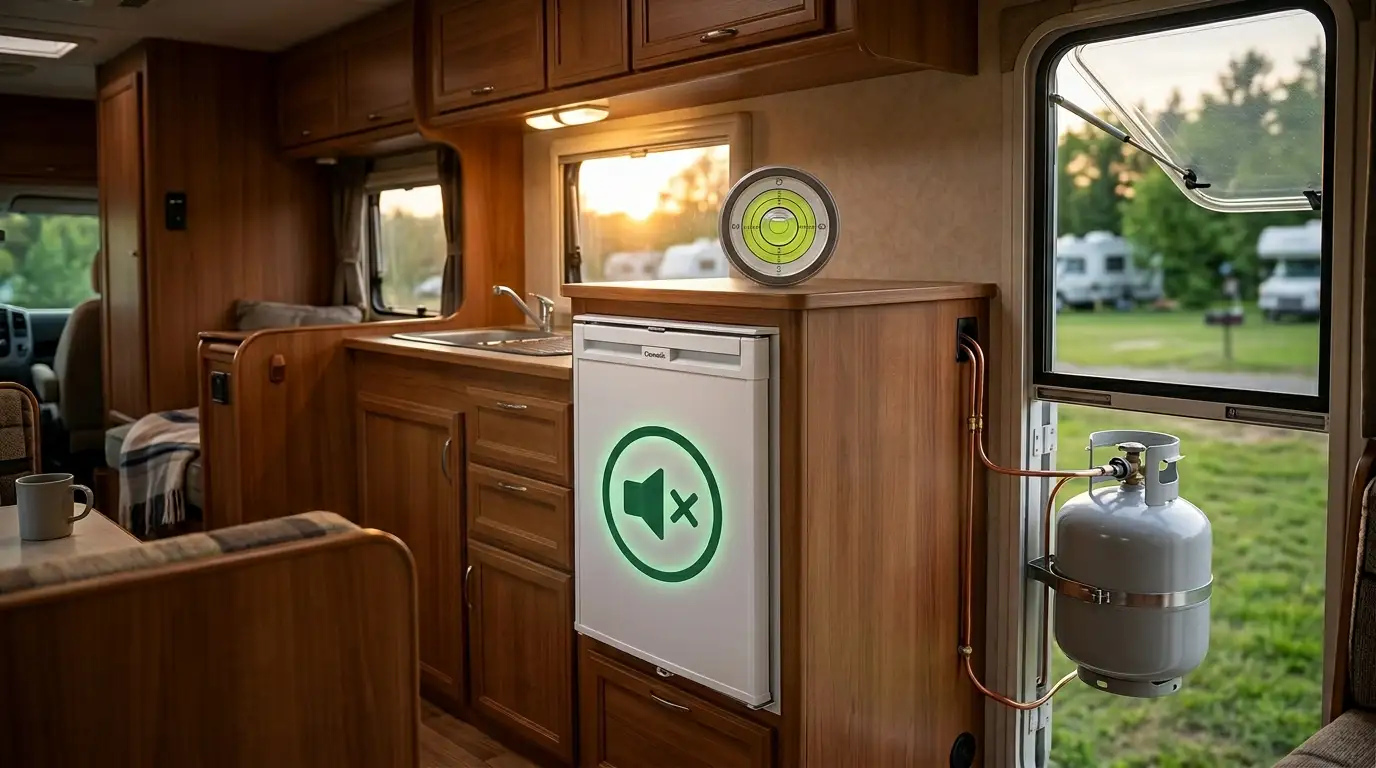
Propane refrigerators, often called “3-way fridges” because they can run on propane gas, AC shore power, or DC battery power, use a completely different mechanism called absorption cooling.
They do not have a motor, a pump, or any moving parts whatsoever. Instead, they use a small, continuously burning propane flame to heat a complex, pressurized chemical mixture of water, ammonia, and hydrogen gas inside a sealed boiler. This heat creates a chemical reaction and vapor cycle that physically absorbs heat from the fridge interior as the ammonia evaporates and condenses.
The Power Source
Off-grid, these units rely entirely on burning liquid propane tanks. (While they can technically run on 12V DC power via a resistive heating element, they are incredibly inefficient on electricity and will drain a massive lithium battery bank in mere hours. The DC function is strictly meant to be used only while your vehicle engine is running and the alternator is actively maintaining the chill).
The Pros & Cons of Propane Fridges
- ✅ Pro – Perfect Silence: Because there is absolutely no mechanical compressor, no fan, and no motor, an absorption fridge is 100% silent. You will only hear the faint, occasional hiss of the pilot light.
- ✅ Pro – Battery Independence: If you live in a dense forest in the Pacific Northwest, or a perpetually cloudy climate where solar panels severely struggle to charge your batteries, a propane fridge is a lifesaver. A standard 20lb BBQ propane tank can run an absorption fridge continuously for 2 to 3 weeks without requiring a single amp of solar power.
- ❌ Con – The Leveling Rule (Fatal Flaw): This is the biggest drawback for mobile living. The internal ammonia cycle relies entirely on gravity to return the liquid to the boiler. If the fridge is not perfectly level (usually within 3 degrees), the liquid pools in the tubes, the cooling cycle stops, and the sodium chromate rust inhibitor crystallizes. This crystallization will permanently block the tubes and ruin the $1,500 cooling unit forever.
- ❌ Con – Extreme Heat Struggles: Absorption fridges are highly dependent on ambient air passing over their rear fins. They usually only cool about 40°F to 45°F below the ambient room temperature. If your off-grid cabin hits 95°F on a summer day, your fridge might struggle to stay below a dangerous, food-spoiling 55°F.
- ❌ Con – Safety Venting: Burning propane produces carbon monoxide and massive amounts of heat. You absolutely must install complex, sealed exhaust vents (usually one on the side wall for intake, and one on the roof for exhaust) to prevent fatal gas buildup inside your living space.
III. Quick Comparison: 12V DC vs Propane
| Feature | 12V DC Compressor Fridge | Propane (Absorption) Fridge |
|---|---|---|
| Primary Fuel | Solar / Battery Bank | Liquid Propane Gas |
| Noise Level | Low (Motor humming) | 100% Silent |
| Must Be Perfectly Level? | No (Tolerates 30° angles) | Yes (Will break if tilted) |
| Cooling in 100°F Heat | Excellent (Stays at 34°F) | Poor (Struggles to stay under 50°F) |
| Exterior Venting Required? | No | Yes (Mandatory CO exhaust) |
IV. The Verdict: Which One Should You Buy?

The off-grid refrigeration debate boils down entirely to your physical environment. Does your home move, or is it stationary?
Choose a 12V DC Compressor Fridge If…
You are building a campervan, an overlanding rig, or outfitting a boat. If your home actively moves, bounces, takes sharp turns, and parks on uneven, rocky terrain, an absorption fridge will quickly fail. A 12V compressor fridge gives you the ultimate freedom to park on a hill, rely entirely on renewable solar energy, and completely eliminate the massive danger of carrying combustible propane gas and venting carbon monoxide inside a small vehicle.
Choose a Propane (Absorption) Fridge If…
You are building a permanent, stationary off-grid cabin, a tiny home, or a traditional RV that is always parked on leveled, poured concrete pads. If you are setting up a basecamp deep in the woods where thick tree canopies block your solar panels for days on end, hauling in a few cheap tanks of propane is a much more reliable and significantly cheaper solution than trying to build a massive, $3,000 lithium battery bank.
V. Critical Medical & DIY Warnings

A Final Warning on Medical Storage:
Whether you choose a rugged 12V system or a silent Propane unit, bulk off-grid food fridges have massive internal temperature zones that fluctuate wildly as you open and close the door in extreme outdoor environments. If you are traveling with highly temperature-sensitive prescriptions (like insulin, Ozempic, or biologics), neither of these appliances is safe enough.
You must use dedicated, fail-safe medical tech with a true digital thermostat. Read our guide on the Best Portable Insulin Cooler for Travel to securely protect your health off-grid.
The DIY Modification Trap:
Tempted to save money by just buying a cheap $100 AC dorm fridge from a big-box store and cutting it up to fit flush into your custom van cabinets? Be extremely careful. Read our mandatory DIY safety guide on How to Find Coolant Lines in a Mini Fridge Before Drilling so you don’t accidentally release the pressurized Freon gas and permanently destroy the appliance before you even hit the road.
Explore the Refrigerator Hub
Don’t stop here! Dive deeper into appliance mechanics and discover the best setups tailored specifically for off-grid living, custom kitchens, and van life.
FAQ: Off-Grid Fridges & Power Systems
2026 Guide: 12V, Propane, and Solar Storage Solutions
Off-Grid Tip: A 12V compressor fridge is drastically more energy-efficient than running a 120V residential fridge through an AC inverter.

