
Best Inkbird ITC-308 Temperature Controller Setup: The Ultimate Guide (2026)
You know that exact moment of crushing disappointment: you’ve carefully brewed the perfect batch of hazy IPA, or you’ve spent three days tending to your delicate sourdough starter. You put the vessel in a dark closet to ferment, crossing your fingers and hoping for the best, only to find out a sudden overnight cold snap stalled the yeast completely. Or worse, a sudden afternoon heatwave caused it to over-ferment, producing aggressive fusel alcohols that make your beer taste like harsh rubbing alcohol. Yeah. It’s incredibly frustrating to lose a whole batch of hard work to unpredictable ambient room temperatures.
Honestly, finding the best Inkbird ITC-308 temperature controller setup is the ultimate, undisputed secret to moving from an amateur hobbyist to producing professional-grade beer, bread, and charcuterie right at home. What most beginners simply don’t realize is that the Inkbird itself is merely the “brain.” To unlock its true power, you cannot just buy the controller; you need to build a complete ecosystem—a dedicated, insulated fermentation chamber that can actively heat and cool automatically. If your ferments are currently at the mercy of your home’s central thermostat, we need to fix your process immediately. Let’s build the perfect, fully automated temperature-controlled chamber.
📊 Quick Comparison: The Complete Fermentation Ecosystem
Do not just buy the controller and assume your job is done. Here is the exact hardware you need to build the ultimate automated fermentation chamber.
| Setup Component | Top Product Choice | Role in the Ecosystem | Key Feature |
|---|---|---|---|
| 1. The Brain | Inkbird WiFi ITC-308 | Controls electrical power to heat/cold relays | WiFi App Monitoring |
| 2. The Cold Source | Danby Designer 1.7 cu.ft | Drops ambient temperature when too hot | “All-Fridge” (No internal freezer) |
| 3. The Heat Source | VIVOSUN 10″x 20.75″ Mat | Raises temperature during cold nights | 20W Low-Energy Infrared |
| 4. The Moisture Fix | Eva-Dry E-500 Dehumidifier | Stops internal condensation and mold | Cordless Renewable Silica Gel |
I. Exothermic Yeast & The Dual-Relay Solution
Before buying hardware, you must understand the thermodynamics of fermentation. Actively fermenting yeast creates its own heat (an exothermic reaction). During peak fermentation, the liquid inside your bucket can easily be 5°F to 8°F hotter than the ambient air in the room. This is why putting a carboy in a 68°F closet often results in a 75°F beer, ruining the batch.
How the Dual-Relay Actually Works
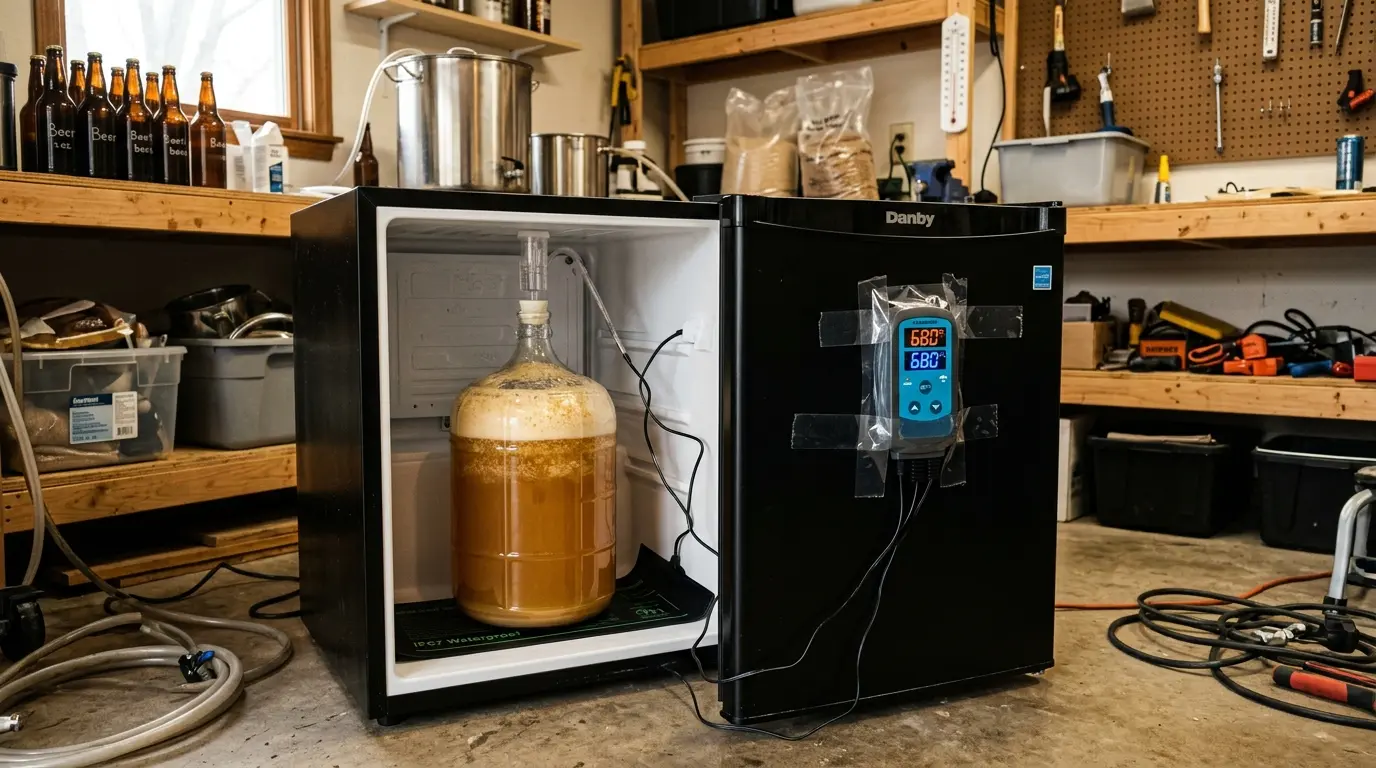
In real-world use, setting up an Inkbird is incredibly simple. The controller acts like a smart HVAC thermostat for your mini fridge. It has two heavy-duty plugs dangling from it: one labeled “Heating” and one labeled “Cooling.” You plug your mini fridge’s power cord directly into the “Cooling” outlet, and your heat mat into the “Heating” outlet. You then stick the metal temperature probe inside the fridge, attached to your bucket.
The Automated Micro-Climate
If you set your target to 68°F (20°C), the Inkbird will automatically cut the electrical power to the fridge if the liquid gets too cold and instantly turn on the heat mat. If the exothermic yeast gets too hot, it turns off the heat mat and kicks on the fridge compressor. It is a completely automated, “set it and forget it” system. For a comprehensive deep dive into the actual wiring process, check out our masterclass: Inkbird ITC-308 Mini Fridge Setup for Fermentation.

1. The “Brain”: Inkbird WiFi ITC-308 Digital Controller
This is the absolute command center of your entire setup. While there is a slightly cheaper non-WiFi version available, the WiFi ITC-308 model is absolutely mandatory for modern home brewers, bakers, and makers in 2026.
Why it’s a top pick:
- Remote App Monitoring: Since a complex fermentation can take anywhere from 2 weeks (ales) to 6 months (sour beers), the 2.4GHz WiFi connectivity allows you to monitor your temperature data logs from your phone via the Inkbird app, no matter where you are in the world.
- Heavy-Duty Relays: It seamlessly manages both heating and cooling simultaneously, handling up to a massive 1100W load, meaning it won’t burn out when your fridge compressor draws a starting surge.
- Safety First (Compressor Delay): It features highly programmable high/low-temperature alarms. Most importantly, it features “compressor delay protection” (the PT setting). This vital software prevents your fridge compressor from burning out by stopping it from turning on and off too rapidly if the temperature fluctuates.
👉 Best for: The foundational, required control unit for literally any homebrew, kombucha, charcuterie, or sourdough proofing setup.
 Check Price & Availability on Amazon

2. The Cold Source: Danby Designer 1.7 cu. ft. Compact Refrigerator
You cannot use just any cheap mini fridge for a fermentation chamber. You must avoid standard dorm fridges with those small, exposed internal freezer boxes. The Danby Designer is a true “all-refrigerator,” which is critical for brewer success.
Why it’s a top pick:
- No Freezer Compartment: Standard mini freezers drip water and create uneven, freezing cold spots that shock the yeast at the top of your bucket. The Danby “All-Fridge” eliminates this entirely, giving you maximum vertical space for tall carboys, brewing buckets, or large stacked sourdough bannetons.
- Mechanical Thermostat: This is a vital technical requirement. When the Inkbird cuts the electrical power to the fridge and then turns it back on, mechanical fridges automatically resume cooling. Modern digital fridges often stay “off” in standby mode until you manually press a button, which completely ruins the automation setup.
- Flat Interior: The completely flat floor and removable wire shelves allow you to customize the space exactly to your brewing or baking vessels.
💡 Baker’s Note: If you are strictly using this setup for artisan baking rather than brewing 5-gallon batches of beer, you might also enjoy reading our comprehensive guide on the Best Sourdough Proofer Alternatives to explore thermoelectric wine cooler options.

3. The Heat Source: VIVOSUN 10″x 20.75″ Seedling Heat Mat
When the ambient temperature of your garage or basement drops in the dead of winter, the Inkbird needs a way to warm the fridge up. A low-wattage, flat heat mat is vastly safer and more effective than using a space heater or a lightbulb.
Why it’s a top pick:
- No UV Light Degradation: Old brewers used to put a 60W lightbulb in their fridge for heat. However, UV light famously “skunks” beer hops (creating that terrible Heineken-in-the-sun taste). The VIVOSUN mat emits zero light, preserving your beer’s complex chemistry perfectly.
- Low Wattage & Safe: At only 20W, it uses barely any electricity and will never melt the plastic walls of the fridge like a space heater would. It is IP67 waterproof, meaning if your airlock violently bubbles over or you spill some wort, the mat will not short circuit and cause a fire.
- Perfect Fit: At 10×20 inches, it fits perfectly on the bottom floor of the Danby 1.7 cu.ft fridge. Just place your fermentation bucket directly on top of it.
👉 Best for: Safe, low-profile, lightless heating inside tight, enclosed plastic spaces.

4. The Moisture Fix: Eva-Dry E-500 Dehumidifier
This is the absolute secret weapon that most beginners forget to buy. When you constantly heat and cool a sealed plastic box (the fridge chamber), you inevitably create massive amounts of condensation. If left unchecked, this moisture will grow thick mold, rust your fridge’s internal components, and destroy the cardboard boxes of your yeast packets.
Why it’s a top pick:
- 100% Cordless Operation: You don’t have an extra outlet inside the fridge to plug in an electronic dehumidifier. The Eva-Dry E-500 uses renewable silica gel beads to absorb up to 8 oz of moisture completely silently and wirelessly.
- Reusable for 10 Years: When the indicator beads turn from orange to green, the unit is full. You simply take it out, plug it into a standard wall outlet in your kitchen overnight to internally “bake” the moisture out, and it’s ready to go back into the fridge. No messy refills.
- Protects Your Gear: Keeping the ambient humidity down stops black mold from forming on your artisan sourdough baskets and keeps your fancy beer labels from peeling off the bottles. (We highly recommend this exact same logic and hardware in our troubleshooting guide on How to Stop Condensation in a Mini Skincare Fridge).
The 3-Minute Chamber Setup Guide
Once you have all four hardware components delivered, putting your ultimate, professional setup together takes less than 10 minutes. No specialized tools required.
1. Prep & Place
Remove all the glass or wire shelves from the Danby fridge to make room for your primary fermenter. Place the Eva-Dry dehumidifier in the back corner. Lay the VIVOSUN heat mat perfectly flat on the bottom floor of the fridge. Gently route the mat’s power cord out through the front of the fridge door hinge (the rubber magnetic gasket will conform around the wire and still seal tightly).
2. Connect the Brain
Plug the Inkbird ITC-308 main power cord directly into your home’s wall outlet. Plug the Danby fridge’s power cord into the “Cooling” socket on the Inkbird. Plug the VIVOSUN mat’s cord into the “Heating” socket. Route the Inkbird’s metal temperature probe inside the fridge via the door gasket.
3. Insulate the Probe
This is critical: For liquid fermentation (like beer or kombucha), tape the Inkbird metal temperature probe directly to the outside wall of your fermentation bucket. Cover the probe completely with a piece of foam, a sponge, or thick bubble wrap, taping it tightly to the bucket. This insulates the probe from the ambient fridge air, ensuring the Inkbird is reading the exact temperature of the liquid inside the bucket, not the cold air blowing around it.
Frequently Asked Questions
⚠️ Can I drill a hole in the fridge for the cables?
We absolutely do not recommend drilling unless you are a refrigeration technician and know exactly where the high-pressure freon lines are routed inside the plastic walls. Drilling blindly into a coolant line will permanently destroy the fridge and release toxic gas instantly. The cables for the Inkbird probe and the heat mat are thin enough that you can safely run them out through the front rubber magnetic gasket of the fridge door without causing a severe air leak. For more safety protocols, read How to Find Coolant Lines in a Mini Fridge Before Drilling.
What should I set the compressor delay to?
Always set the Compressor Delay (the “PT” setting on the Inkbird app) to at least 3 minutes (some brewers prefer 5 minutes). This crucial setting prevents the heavy fridge compressor from violently turning on immediately after it was just turned off by a slight temperature shift, which can cause the motor to seize and lead to permanent mechanical failure.
Do I need the heat mat if I live in a hot climate?
If your fermentation fridge is located in a sweltering garage in Texas and you are only brewing cold-fermented lagers, you may not need the heat mat plugged in during the summer. However, for sourdough proofing, winter brewing, or brewing Kveik yeast (which requires aggressive temperatures upwards of 90°F to express its fruity esters), the heat mat is absolutely essential to hold the temperature against the cold coils of the fridge.

