
Vacuum Sealing vs. Butcher Paper for Venison: Preventing Freezer Burn (2026 Guide)
You spent months meticulously scouting public land, endured freezing, brutal temperatures in the treestand, and dedicated an entire, exhausting weekend to field-dressing and butchering your harvest. But the true, ultimate test of a successful hunting season doesn’t actually end on the stainless steel processing table—it ends months later in the deep freeze.
Venison is an incredibly lean, premium, and highly volatile protein. Because wild game completely lacks the heavy, protective intramuscular fat (marbling) found in commercial feedlot beef, it is highly susceptible to aggressively drying out and developing catastrophic freezer burn. If you package your hard-earned backstraps incorrectly, they will taste like dry, metallic cardboard by the time summer grilling season arrives.
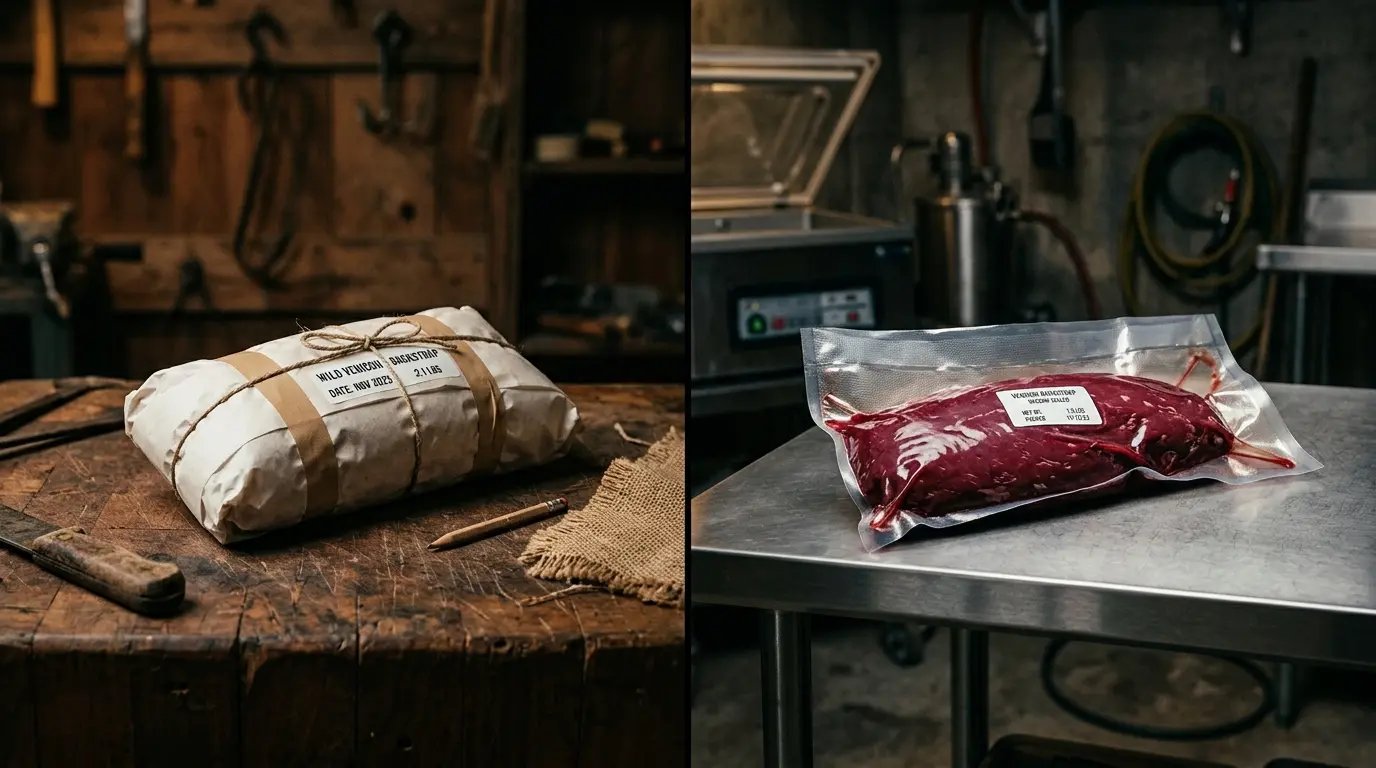
For generations, hunters have fiercely debated the absolute best way to protect their organic harvest. In one corner sits the time-honored, economical tradition of heavy-duty Butcher Paper. In the other corner sits the high-tech, airtight security of modern Vacuum Sealing. In this comprehensive breakdown, we aggressively compare the thermal protection, maximum shelf life, and processing workflow speeds of both methods to ensure your deer tastes just as fresh in August as it did in November.
The Quick Answer
Vacuum Sealing is the absolute gold standard for long-term preservation, extending the life of premium venison cuts (like backstraps and tenderloins) to 2 to 3 years by entirely halting oxidation and sublimation. However, it is a slow process that requires expensive plastic bags. Butcher Paper (Freezer Paper) is vastly cheaper and exponentially faster for wrapping massive 100-pound yields of ground meat or sharp, bone-in roasts, but its failure to remove 100% of the air limits the safe freezer lifespan to 6 to 9 months before noticeable flavor degradation begins.
For a deeper look into the exact machinery used for big game processing, explore our master directory: Vacuum Sealing Excellence: The Definitive Guide for 2026.
I. The Biology: Why Venison is So Vulnerable
To truly understand why your packaging material matters so deeply, you must understand the exact physics of how a deep freezer systematically ruins meat.
The Science of Sublimation
Freezer burn is scientifically known as sublimation. In the incredibly dry, arid, sub-zero environment of a freezer, the microscopic water molecules locked inside the meat transition directly from a solid (ice) into a gas (vapor) without ever passing through a liquid phase.
This moisture physically evaporates out of the meat and crystallizes onto the interior of the packaging. As the moisture leaves, the exposed muscle fibers become permanently dehydrated. The meat turns a dull, lifeless gray, and takes on a distinctly rancid, metallic flavor known as oxidation.
The Venison Flaw: Lack of Fat
Commercial beef (like a Prime Ribeye) has a massive exterior fat cap and dense intramuscular marbling. This heavy fat acts as a biological shield, heavily insulating the delicate muscle fibers from the dry freezer air. Venison, elk, and moose are incredibly lean, wild-foraging animals. Because wild game lacks this protective fat layer, ambient air directly attacks the bare muscle tissue, causing wild game to freezer-burn at almost double the speed of domestic beef. Air is the ultimate enemy.
II. The Butcher Paper Tradition (The Fast & Economical Route)
Long before $200 countertop vacuum appliances existed, professional butchers and generations of hunters relied exclusively on thick, heavy-duty freezer paper to protect their meat.
Note: True freezer paper is not standard brown craft paper or wax paper. It is a high-grade paper coated on one single side with a thin, impenetrable layer of polyethylene plastic. You place the meat directly against the shiny plastic side to lock in the moisture, while the paper exterior protects against physical freezer abrasion.
The Pros of Butcher Paper
- Unmatched Processing Speed: If you have 100 pounds of meat on the table and three friends helping you process, vacuum sealing will take hours. With a heavy roll of freezer paper and a tape dispenser, an experienced hunter can flawlessly “butcher wrap” a massive pile of steaks in a matter of minutes.
- Immunity to Sharp Bones: Paper cannot be popped or deflated. The thick, fibrous nature of the paper easily wraps around jagged neck roasts and sharp bone-in shanks without tearing or compromising the packaging.
- Incredibly Economical: A massive 1000-foot roll of commercial poly-coated freezer paper costs roughly $40. It will easily wrap five entire deer, making the cost-per-cut practically zero.
The Cons: The Time Limit
No matter how flawlessly you execute the classic “tuck and roll” butcher’s wrap to push the air out before taping it shut, paper is folded, not sealed. Micro-pockets of ambient air will inevitably remain trapped directly against the meat.
Over a period of months, oxygen slowly penetrates the folds. Because of these trapped air pockets, meat wrapped tightly in butcher paper has a maximum safe freezer life of 6 to 9 months before noticeable desiccation, graying, and flavor degradation strictly begin.
III. Vacuum Sealing: The Modern Standard
Vacuum sealing completely removes human error from the wrapping equation. By utilizing a motorized appliance to physically, aggressively suck 100% of the oxygen out of a heavy-duty, multi-layered nylon plastic pouch, you create an impenetrable, chemically stable micro-climate for your venison.
The Pros of Vacuum Sealing
- Absolute, Uncompromising Protection: Because a true vacuum seal removes the atmosphere entirely, the physical process of sublimation and oxidation is completely, entirely halted. As we mapped out in our lifespan chart inside How Long Does Vacuum Sealed Meat Last in the Freezer?, a vacuum-sealed venison backstrap can easily survive 2 to 3 years in a deep chest freezer with absolutely zero loss of flavor, moisture, or tenderness.
- Sous Vide Ready: If you cook your wild game using modern immersion circulators, the meat is already perfectly sealed in high-heat-rated plastic and ready to be dropped directly from the freezer into the water bath.
The Cons: Time and Machinery Costs
Operating a standard, $150 countertop external suction machine (like a FoodSaver) is incredibly tedious. You must carefully wipe the seal lines dry, wait for the motor to pull a vacuum, wait for the heat bar to melt the plastic, and then wait 30 seconds for the machine to cool down before sealing the next bag.
Furthermore, proprietary textured plastic rolls are expensive. If you are processing a massive bull elk, you could easily spend $60 to $80 purely on plastic bags. (Note: Serious, high-volume hunters completely bypass this slow process by upgrading to commercial, oil-cooled hardware, which we rigorously test in our LEM MaxVac vs. MEAT! Chamber Sealer Showdown).
IV. The Sharp Bone Dilemma (Why Vacuum Bags Fail)
If vacuum sealing is so scientifically and biologically superior, why do so many veteran hunters refuse to use it and stubbornly stick to paper? Because of punctures.
Wild game processing inherently involves sharp knives, bone saws, and incredibly jagged, splintered bones. The sharp edge of a sawed-off venison shank, a sharp rib bone, or the jagged edge of a neck roast will easily, effortlessly pierce a standard 3-mil thick vacuum bag when placed under the intense, crushing atmospheric pressure of the vacuum pump.
Once that plastic bag is punctured—even by a hole the size of a microscopic pinprick—the vacuum seal is immediately broken. Air rushes back into the bag, and the meat will suffer catastrophic freezer burn within weeks.
The Professional Fix: Defeating the Bone
If you are sealing bone-in venison, you cannot just drop it into the plastic. You must actively protect the integrity of the bag using specialized commercial techniques.
- The Hardware Upgrade: Stop using cheap grocery store bags. Upgrade your processing station to heavy-duty, puncture-resistant commercial plastics. Read our guide on Heavy Duty 5-Mil Bags vs Standard Vacuum Bags for Bone-In Meat to find plastics designed to survive the deep freezer.
- The Bone Guard Protocol: You must physically pad the sharp calcium edges before applying the vacuum. You can use cheap, folded paper towels, or invest in heavy-duty waxed canvas bone guards. We break down the exact, step-by-step wrapping protocol in our mandatory guide: Stop Puncturing Bags: How to Vacuum Seal Bone-In Meat Perfectly.
V. The Verdict: Building a Hybrid Processing Strategy
You do not have to fiercely pledge allegiance to just one single method. The smartest, fastest, and most efficient hunters use a Hybrid Approach, packaging different cuts of the animal based entirely on their shape and exactly when they plan to consume them.
Use Butcher Paper For:
- Ground Venison & Bulk Sausage: Because ground meat is wet and packs incredibly densely, it naturally pushes out ambient air on its own. Stuffing ground meat tightly into 1-lb poly meat tubes (and sealing them with a tape machine) or wrapping it in butcher paper is exponentially faster and perfectly safe for chili meat you plan to consume over the winter.
- Massive Bone-In Roasts: For giant, jagged cuts (like shanks or ribs) that are mathematically guaranteed to puncture a plastic bag and ruin the seal anyway.
Use Vacuum Sealing For:
- The Premium Cuts: Your pristine backstraps, delicate inner tenderloins, and prime sirloin steaks deserve absolute, uncompromised protection. Vacuum seal these highly valuable cuts to ensure they remain completely flawless for summer grilling, even if they end up accidentally hiding at the bottom of the chest freezer for two years.
- Jerky and Snack Sticks: Vacuum sealing keeps your painstakingly cured and smoked snack meats from drying out and becoming brittle, dusty, and inedible.
Explore the Vacuum Sealing Hub
Don’t stop here! Dive deeper into the science of preservation, explore heavy-duty bag comparisons, and read our latest commercial hardware reviews for 2026.
FAQ: Ammunition Storage
2026 Guide: Mylar Bags, Desiccants, and Heat Degradation
Tactical Tip: Throwing a single 10-gram silica gel packet into your ammo bag before vacuum sealing guarantees zero corrosion during decadal storage!

