
How to Vacuum Seal Liquids Without a Chamber Sealer: 3 Proven Hacks (2026)
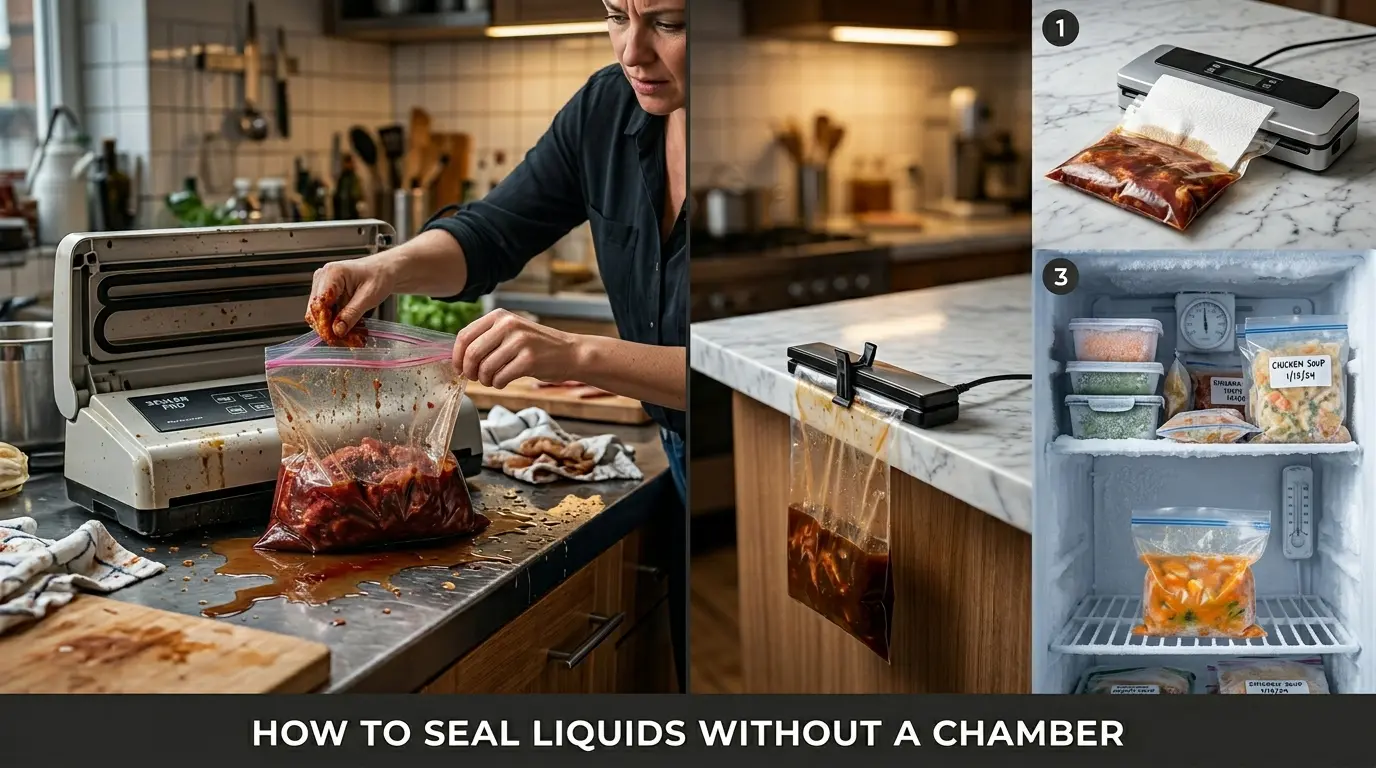
If you have ever excitedly tried to vacuum seal a massive batch of homemade winter chili, or a beautiful flank steak swimming in a rich, oily soy-sauce marinade using a standard household FoodSaver, you already know the catastrophic, messy result.
The machine’s powerful pump aggressively sucks the liquid straight up the bag alongside the air. The liquid hits the red-hot Teflon heating bar, instantly ruining the thermal seal, making a horribly sticky, greasy mess all over your pristine kitchen counter, and potentially permanently destroying your appliance’s internal vacuum pump.
This inherent, frustrating design flaw leads many home chefs to incorrectly believe that sealing wet foods explicitly requires dropping $600+ on a massive, commercial-grade chamber machine. While we highly recommend that premium upgrade for hardcore users in our Chamber Vacuum Sealer vs. External Suction guide, it is not strictly necessary for the average home cook. You can easily outsmart your machine’s physical limitations. In this guide, we break down exactly how to vacuum seal liquids without a chamber sealer using three proven, 100% free kitchen hacks.
The Quick Answer
You do not need an expensive chamber sealer to seal wet foods. For lightly marinated meats, use the Gravity Hang Method by letting the bag hang off the edge of your counter so gravity fights the suction. For juicier meats and thick marinades, use the Paper Towel Dam by placing a folded paper towel strip inside the bag just below the seal line to absorb rogue liquids. For 100% pure liquids like broths and soups, you must use the Pre-Freeze Method by freezing the liquid into a solid slush in an upright bag for 2 hours before running it through the sealer.
For more advanced troubleshooting and preservation techniques, explore our master directory: Vacuum Sealing Excellence: The Definitive Guide for 2026.
1. Hack #1: The Gravity Hang (The Quick Fix)
Standard external suction machines pull air horizontally across your kitchen counter. If the bag is laying flat on the counter, the liquid will naturally pool and get dragged horizontally straight into the drip tray. By simply changing the physical orientation of the bag, you can use gravity to fight the machine’s suction power.
- The Technique: Pick up your vacuum sealer and physically place it right at the absolute edge of your kitchen counter. Place your liquids or marinated meat into the bottom of the plastic bag. Instead of laying the bag flat on the counter, insert the open rim into the machine and let the long body of the bag hang vertically off the edge of the counter, pointing straight down toward the floor.
- How it Works: Physics is now on your side. Gravity pulls the heavy, dense liquid down to the bottom of the hanging bag, while the vacuum pump pulls the lighter, ambient air straight up and out.
- The Catch (Manual Intervention): You cannot just hit the “Auto” button and walk away. You must watch the liquid line incredibly closely! As the bag aggressively shrinks and the air is removed, the sheer vacuum pressure will eventually start to creep the liquid upward against gravity. You need to press the manual “Seal Only” button on your machine just a fraction of a second before the rising liquid reaches the heating element.
Best Used For: This hack is absolutely perfect for sealing moderately wet, oil-coated items like steaks or salmon filets preparing for the water bath. (For more immersion techniques, see our Best Vacuum Sealer for Sous Vide Cooking guide).
2. Hack #2: The Paper Towel Dam (Best for Marinades)
If you are dealing with excessively juicy steaks, freshly washed fish, or heavily marinated proteins swimming in soy sauce and vinegar, the gravity hang method might simply not be enough. The pump will overpower gravity. In this scenario, the paper towel hack is the most reliable, foolproof way to protect your machine’s fragile heating element.
- The Technique: Cut a standard, high-quality, unbleached paper towel into a rectangular strip about 2 inches wide. Fold it so it spans the entire horizontal width of your vacuum bag. Insert your food and liquid marinade into the bottom of the bag. Finally, carefully slide the paper towel strip into the bag, placing it horizontally about 1.5 to 2 inches below the top opening (just underneath where the machine will clamp down to seal).
- How it Works (Capillary Action): As the machine engages and sucks the air out, the juices are inevitably pulled upward toward the motor. However, the folded paper towel acts as a physical, highly absorbent sponge. It aggressively absorbs the rogue liquids before they can bridge the gap and cross the critical seal line. The machine achieves a perfect, dry, plastic-on-plastic thermal weld directly above the damp paper towel.
Why Moisture is the Enemy
If even a microscopic drop of liquid touches the red-hot Teflon heating bar during the sealing phase, it instantly turns into steam. This steam physically cools the heating wire and creates a watery barrier between the two layers of plastic, permanently preventing them from melting together and fusing. For a deeper look into exactly why moisture destroys your plastic welds and ruins your deep-freeze storage, read our diagnostic guide: Vacuum Sealer Not Sealing Wet Foods? Here’s the Fix.
3. Hack #3: The Pre-Freeze Method (Best for Pure Soups)
If you are trying to vacuum seal 100% pure liquid items—like gallons of homemade chicken stock, pureed tomato soups, or massive, party-sized batches of wet chili—the gravity hang and the paper towel hack will both fail spectacularly. The sheer volume of liquid will instantly overflow the paper towel. You must manipulate the physical state of the liquid itself.
- The Technique (Leave Headspace): Pour your soup or broth directly into the vacuum bag. Leave the top rim completely open. Crucial Note: Always leave at least 3 inches of empty space at the top of the bag, because liquids physically expand as they freeze. Place the bag upright inside a tall Tupperware container or a plastic pitcher (to keep it from tipping over and spilling) and put it in your deep freezer.
- The Timing: Wait roughly 1.5 to 2.5 hours. You do not need the soup to become a rock-solid, impenetrable brick of ice; you just need the top surface to freeze into a thick, hardened icy slush that refuses to flow.
- The Final Seal: Take the semi-frozen bag out of the freezer, wipe any frost off the outside, and vacuum seal it normally on your kitchen counter. Because the liquid has solidified into a highly viscous state, the machine cannot physically suck it into the pump, resulting in a flawless, perfectly dry, airtight seal.
4. The Commercial Shortcut: Liquid Block Bags
If you find yourself constantly battling gravity at the edge of your counter, or you absolutely hate waiting two hours for your Sunday meal-prep soup to freeze, there is a specialized commercial product designed explicitly to solve this problem without requiring you to buy a brand new machine.
Liquid Block Bags (or “Liquid Catch” bags) are specialized, heavy-duty vacuum rolls that feature a thick, highly absorbent strip (often made of food-safe cellulose or hydro-polymers) fused directly into the inner plastic lining near the top opening. You simply drop your dripping wet food in and seal it completely normally; the built-in strip automatically does all the work of the paper towel hack, acting as an impenetrable dam.
Are They Worth the Money?
These highly engineered bags are significantly more expensive than standard bulk plastic rolls, meaning you shouldn’t use them for everyday dry goods.
We aggressively compare the ongoing financial cost and efficiency of these premium bags against the free DIY hacks listed above in our economic guide: Liquid Block Bags vs Freezing Liquids Before Vacuum Sealing, and we review the top-performing, leak-proof brands currently on the market in The Best Vacuum Sealer Bags for Wet Food.
Tired of Hacking Your Machine?
If you process large volumes of soup, bone broths, and wet marinades every single week, you are simply using the wrong tool for the job. You have officially outgrown your $100 FoodSaver.
Commercial Chamber Vacuum Sealers do not suck air out of the bag; they evacuate the entire chamber box, equalizing the atmospheric pressure. This means liquids literally never boil or get forced upward. You can seamlessly seal a bag of pure water flawlessly every time using incredibly cheap, smooth bags.
Read: Chamber Sealer vs External Suction (Is the Upgrade Worth It?)Explore the Vacuum Sealing Hub
Don’t stop here! Dive deeper into the science of preservation, explore head-to-head machine comparisons, and read our latest hardware reviews for 2026.
Liquid Block Bags vs Freezing Liquids Before Vacuum Sealing: Which is Better? (2026)
If you own a standard external suction vacuum sealer (like a FoodSaver or Nesco), you already know its absolute greatest, most frustrating weakness: moisture. The exact moment you try to seal a beautifully marinated flank steak, a batch of fresh salsa, or a rich winter stew, the machine’s powerful pump ruthlessly sucks the liquid straight up the bag.
This inevitably ruins the thermal seal by creating a steam barrier, creates a sticky, greasy mess all over your kitchen counter, and risks permanently destroying your expensive internal vacuum pump.
For years, dedicated home cooks and weekend meal preppers have relied on one classic, low-tech workaround to bypass this massive design flaw: Pre-freezing. But recently, packaging manufacturers introduced a high-tech, highly convenient alternative directly to the consumer market: Liquid Block Bags. If you are tired of cleaning raw meat juices out of your drip tray, you have to choose a side. In this comprehensive guide, we compare both methods to determine which offers the best workflow, the lowest cost, and the most reliable seal for your wet foods.
The Quick Answer
Liquid Block Bags are perfect for fast, instant sealing of raw meats, fish, and lightly marinated proteins; they feature an absorbent strip that stops juices from ruining the seal, but they are highly expensive. The Pre-Freeze Method is 100% free and is the absolute only way to seal heavy, pure liquids (like soups, broths, and massive batches of chili) using a standard machine. For the ultimate wet-food prep, using both methods interchangeably is required unless you upgrade entirely to a commercial Chamber Vacuum Sealer.
For a complete look at all our preservation techniques and machine reviews, explore our master directory: Vacuum Sealing Excellence: The Definitive Guide for 2026.
I. The Pre-Freeze Method: The Classic, Free Hack
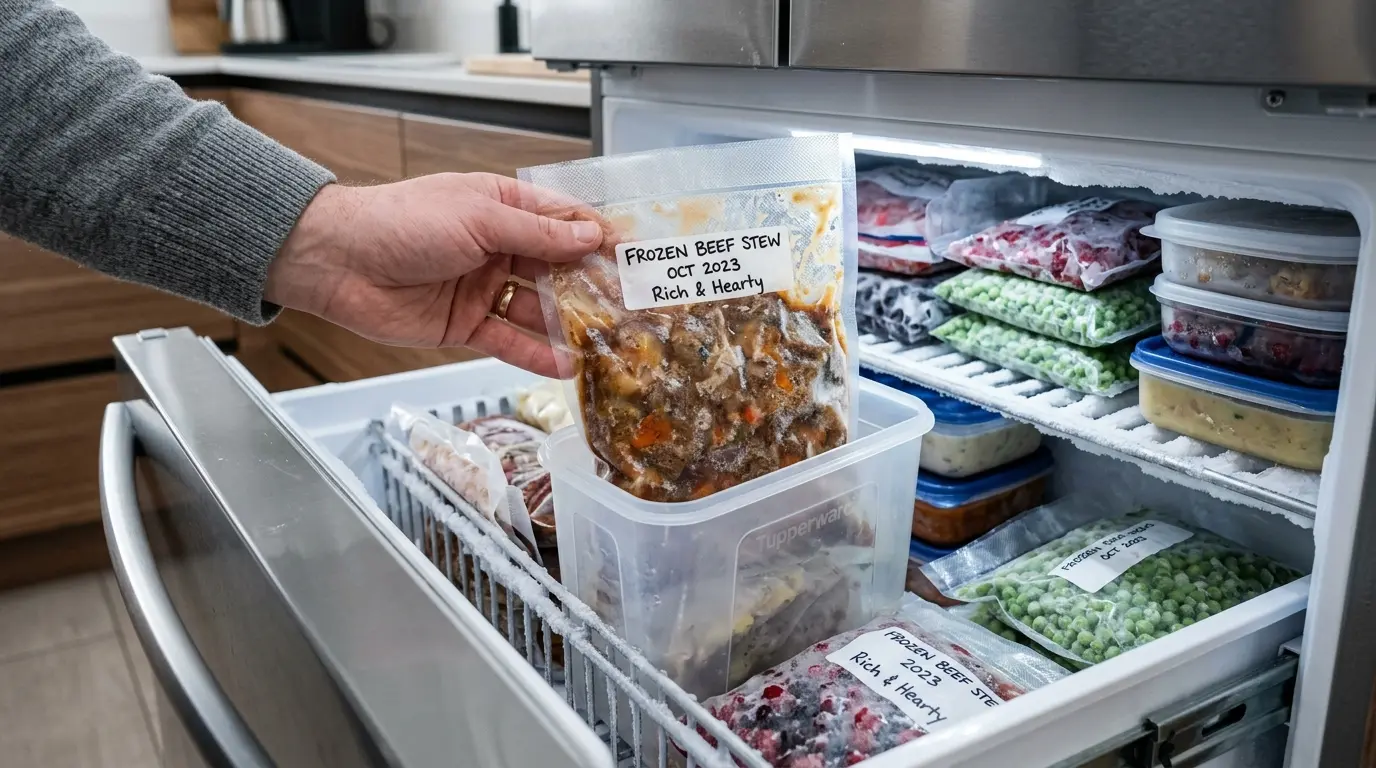
Before specialized high-tech bags existed, the “Pre-Freeze” method was the undisputed, only reliable way to seal soups, stews, and heavily marinated meats without making a catastrophic mess on the kitchen counter. It relies on simply temporarily changing the physical state of the liquid to outsmart the appliance.
How It Works: The Thermodynamics
You pour your liquid soup or place your soaking wet meat directly into a standard, cheap vacuum bag. Instead of sealing it immediately, you prop the bag upright. (Pro tip: placing the unsealed bag into a tall Tupperware container or a large plastic pitcher prevents it from falling over and spilling).
You place the upright bag in the deep freezer for 1 to 2 hours. You do not need the liquid to become a rock-solid, impenetrable brick of ice; you just need the surface liquid to turn into a highly viscous, icy slush. Once the liquid has hardened, you take it out and vacuum seal it normally. Because the moisture is physically frozen in place, the machine’s pump cannot suck it out into the heating element.
The Pros
It is 100% free. You can use your standard, incredibly cheap bulk vacuum bag rolls. Most importantly, it works flawlessly and perfectly even for pure, unadulterated liquids like chicken stock, pasta sauce, and heavy stews.
We cover this exhaustive technique extensively in our tutorial on How to Vacuum Seal Liquids Without a Chamber Sealer.
The Cons
It completely ruins your workflow. If you are trying to meal-prep for the entire month on a busy Sunday afternoon, being forced to wait two hours for bags of chili to freeze creates a massive, frustrating bottleneck in your kitchen. You have to babysit the freezer instead of finishing your chores.
II. Liquid Block Bags: The Modern Convenience
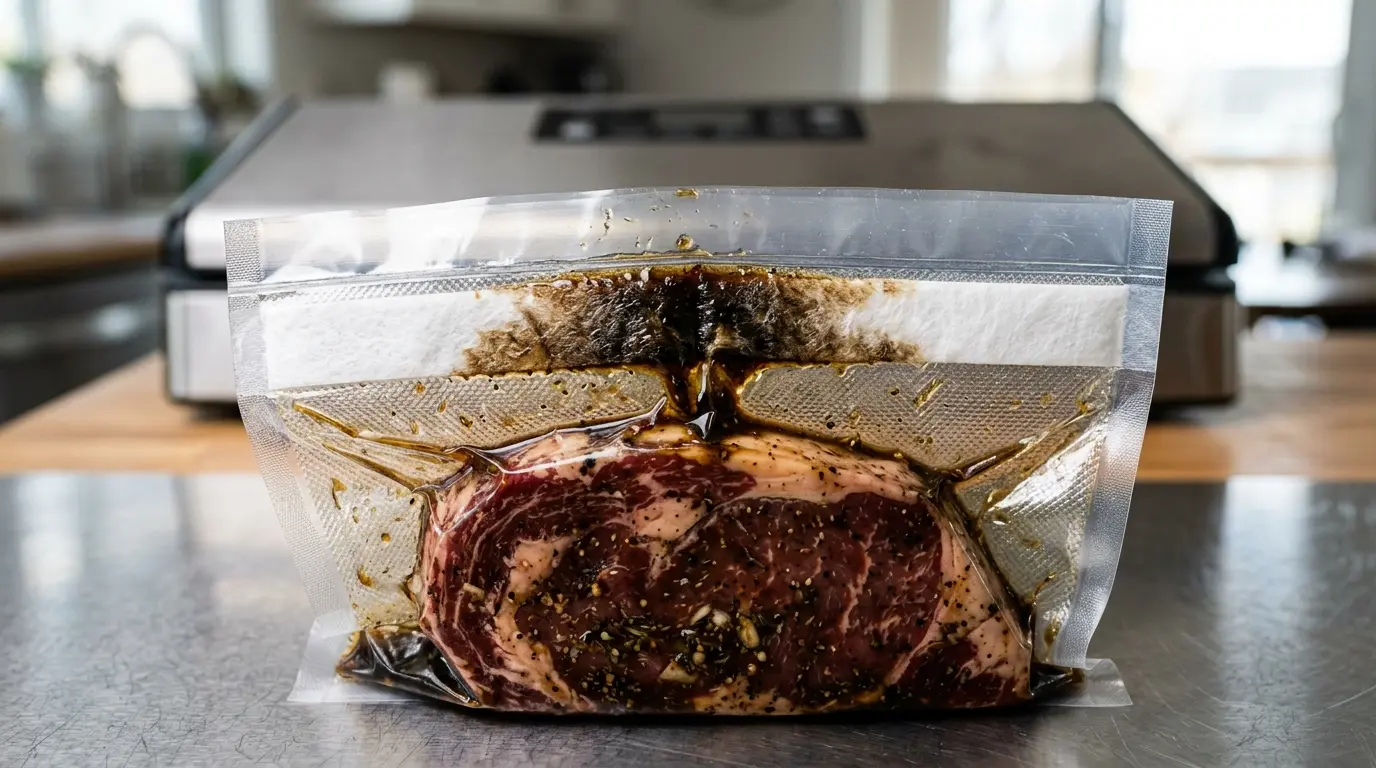
Liquid Block bags (sometimes marketed as “Liquid Catch” or “Moisture Barrier” bags) are specifically engineered by packaging scientists to solve the moisture problem for consumer-grade external suction machines.
How It Works: Capillary Action
From the outside, these bags look exactly like standard embossed vacuum bags. But if you look near the top opening, they feature a thick, highly absorbent strip (often made of food-safe cotton, cellulose, or specialized hydro-polymers) physically fused into the inner plastic lining.
As the machine aggressively sucks the air out of the bag, the rogue liquid is forced to travel upward. When the liquid hits the strip, the material instantly absorbs the moisture like an industrial sponge. This utilizes capillary action to create a physical, dry dam that perfectly protects the critical Teflon heat-seal line at the very top of the bag.
The Pros
Instant gratification. There is zero prep time, zero extra dishes, and absolutely no waiting around. You can drop a dripping, juicy, soy-sauce marinated pork chop directly into the bag and seal it perfectly on the very first try.
To see which specific brands perform best under pressure, read our lab-tested review: The Best Vacuum Sealer Bags for Wet Food: Liquid Block Technology.
The Cons
The “Convenience Tax.” These bags are significantly more expensive than standard bulk plastic rolls (often costing 3 to 4 times as much per bag).
Furthermore, the absorbent strip has a strict physical volume limit. It works flawlessly for meat juices, but it cannot absorb an entire bowl of soup. If you try to seal a bag of pure chili, the strip will instantly overflow and flood your machine.
III. The Showdown: When to Use Which Method
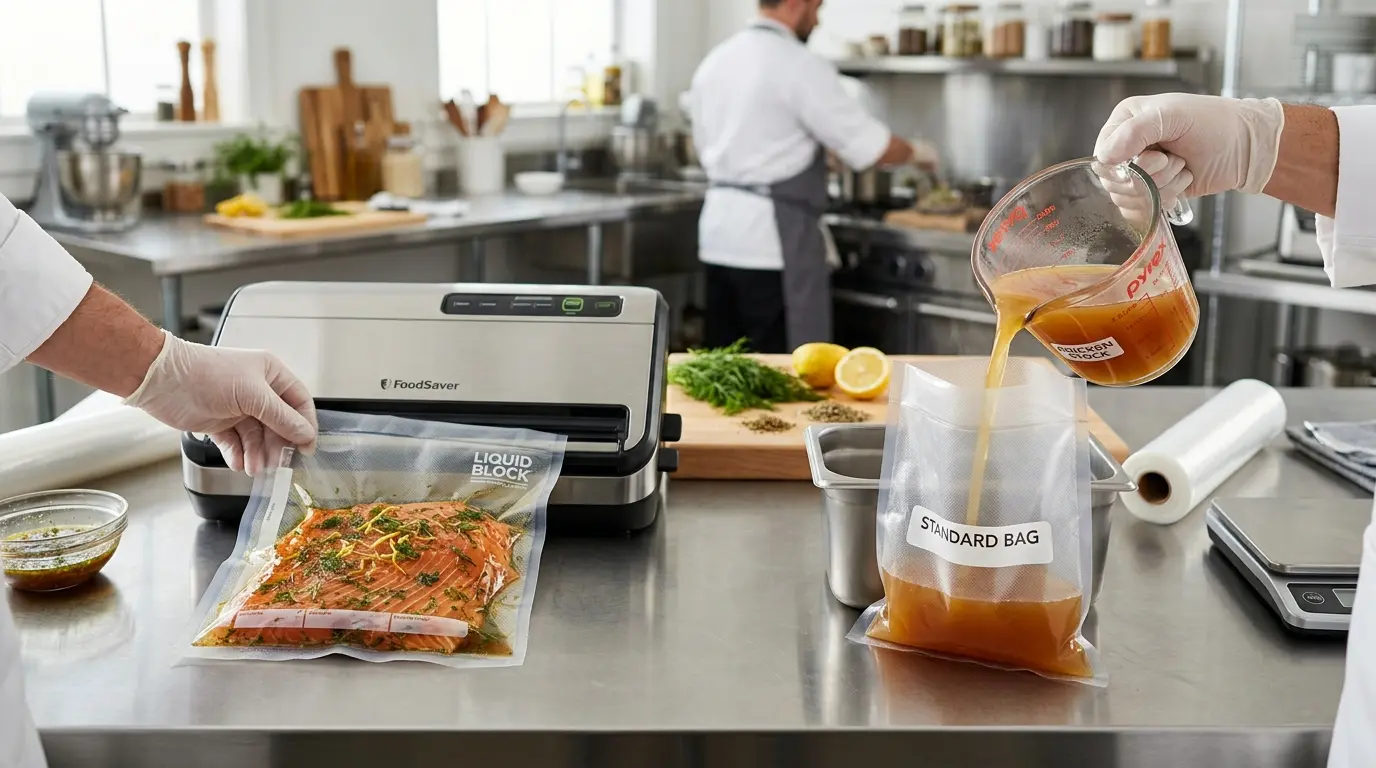
You do not necessarily have to pick just one allegiance. A highly efficient, smart kitchen utilizes both methods interchangeably depending on exactly what is on the prep menu for the day.
Use Liquid Block Bags For:
- Raw Meats: Fresh steaks, chicken breasts, and pork chops naturally release massive amounts of myoglobin and water juices under intense vacuum pressure. Liquid block bags handle this moderate moisture perfectly.
- Light Marinades: If your meat is simply coated in a few tablespoons of olive oil, soy sauce, or thick BBQ sauce, the absorbent strip will trap it easily before it hits the weld.
- Delicate Fish: Seafood is notoriously wet. A liquid block bag ensures a pristine, airtight seal without forcing you to crush the delicate fillets by wiping them too aggressively with paper towels.
Use the Pre-Freeze Method For:
- Pure Liquids: Soups, bone broths, and massive batches of stew will completely and instantly overwhelm a liquid block bag, soaking the strip and ruining the seal. You absolutely must pre-freeze these items.
- Budget Bulk Prepping: If you are processing 50 pounds of cheap ground beef, using highly expensive $0.80 liquid block bags for every single package is a massive waste of money. Pre-freezing or simply patting the meat dry is far more economical.
- Excessive Oil: Thick, oily marinades can sometimes bypass cheap absorption strips. Freezing the oil into a solid fat ensures a perfect seal.
IV. The Ultimate Alternative: Upgrade Your Machine
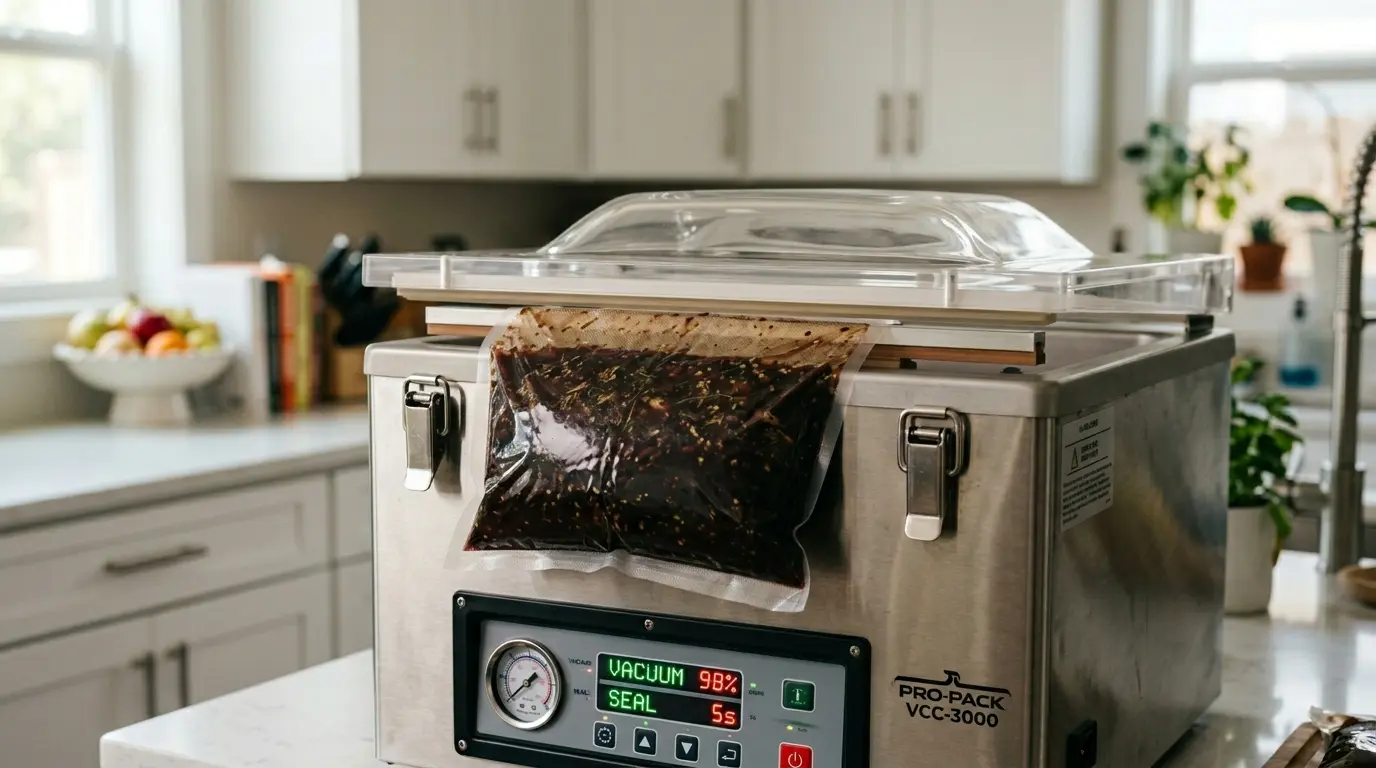
If you find yourself constantly debating between waiting two hours for soup to freeze or spending premium retail prices on highly specialized liquid block bags, you have officially outgrown your appliance.
Neither of these frustrating culinary hacks is necessary if you use a Vacuum Chamber Sealer.
Because heavy-duty commercial chamber sealers equalize the atmospheric pressure inside and outside the bag simultaneously, liquids never boil and they never get sucked out of the bag. You can seamlessly, flawlessly seal a bag of pure, sloshing water using the absolute cheapest, smoothest plastic bags on the market.
Ready to Ditch the Hacks Entirely?
If you process wet foods weekly or are serious about sous vide cooking, it is time to upgrade to the big leagues.
Read: Chamber Vacuum Sealer vs. External Suction (Is the Upgrade Worth It?)Discover how commercial technology handles pure liquids effortlessly and saves you massive money on bag costs over time.
Explore the Vacuum Sealing Hub
Don’t stop here! Dive deeper into the science of preservation, explore head-to-head machine comparisons, and read our latest hardware reviews for 2026.
FAQ: Vacuum Sealing Liquids & Machine Comparison
2026 Guide: Wet Foods, Chamber Sealers, and Pro Hacks
Pro Tip: If using an external sealer for liquids, pre-freeze the soup in a container for 2 hours until it is a “slush” before sealing!
Vacuum Sealing Excellence: The Definitive Guide (2026)
